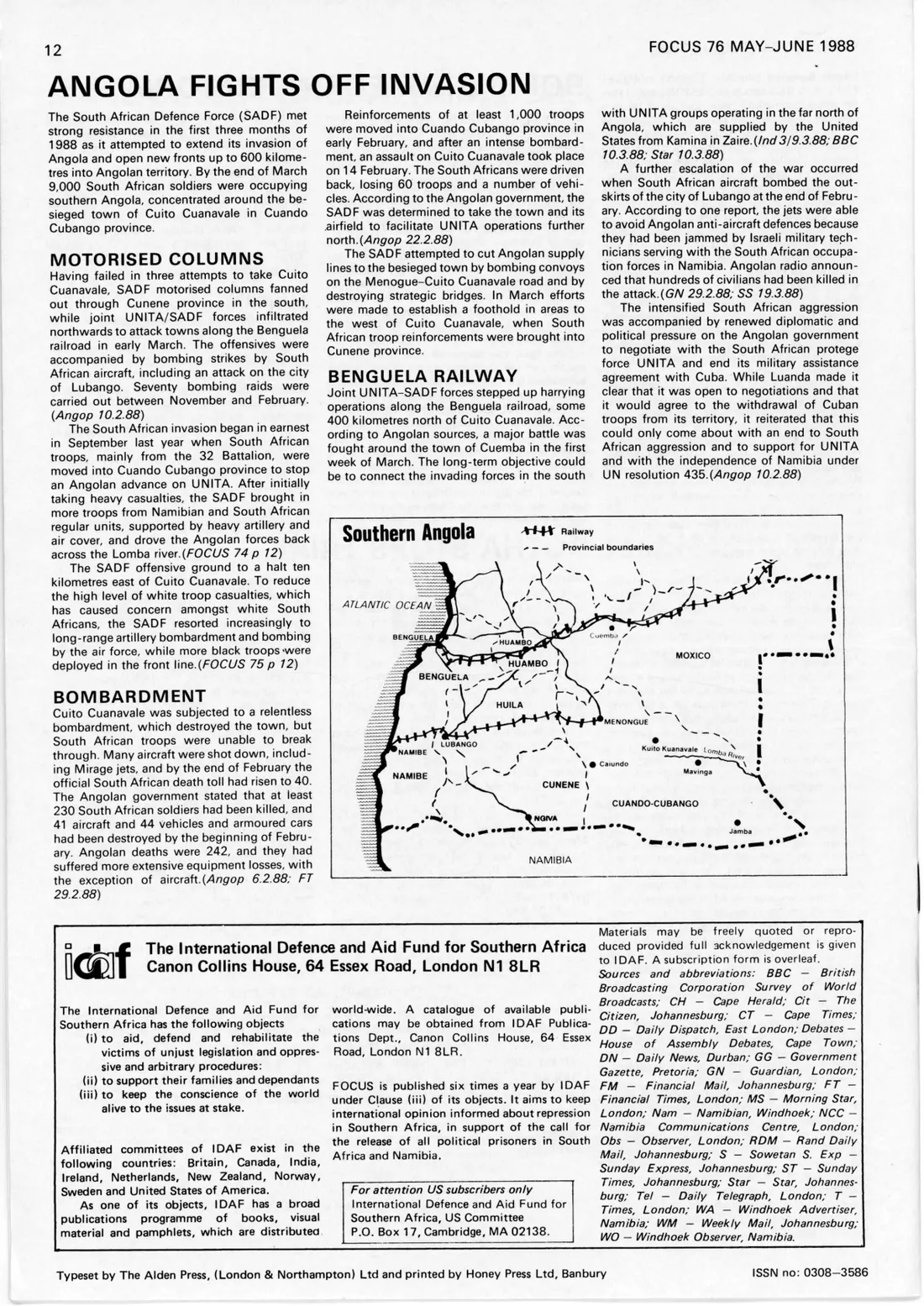
The South African Defence Force (SADF) met strong resistance in the first three months of 1988 as it attempted to extend its invasion of Angola and open new fronts up to 600 kilometres into Angolan territory. By the end of March 9,000 South African soldiers were occupying southern Angola, concentrated around the besieged town of Cuito Cuanavale in Cuando Cubango province.
Having failed in three attempts to take Cuito Cuanavale, SADF motorised columns fanned out through Cunene province in the south, while joint UNITA/SADF forces infiltrated northwards to attack towns along the Benguela railroad in early March. The offensives were accompanied by bombing strikes by South African aircraft, including an attack on the city of Lubango. Seventy bombing raids were carried out between November and February.
The South African invasion began in earnest in September last year when South African troops, mainly from the 32 Battalion, were moved into Cuando Cubango province to stop an Angolan advance on UNITA. After initially taking heavy casualties, the SADF brought in more troops from Namibian and South African regular units, supported by heavy artillery and air cover, and drove the Angolan forces back across the Lomba river.
The SADF offensive ground to a halt ten kilometres east of Cuito Cuanavale. To reduce the high level of white troop casualties, which has caused concern amongst white South Africans, the SADF resorted increasingly to long-range artillery bombardment and bombing by the air force, while more black troops were deployed in the front line.
Cuito Cuanavale was subjected to a relentless bombardment, which destroyed the town, but South African troops were unable to break through. Many aircraft were shot down, including Mirage jets, and by the end of February the official South African death toll had risen to 40. The Angolan government stated that at least 230 South African soldiers had been killed, and 41 aircraft and 44 vehicles and armoured cars had been destroyed by the beginning of February. Angolan deaths were 242, and they had suffered more extensive equipment losses, with the exception of aircraft.
Reinforcements of at least 1,000 troops were moved into Cuando Cubango province in early February, and after an intense bombardment, an assault on Cuito Cuanavale took place on 14 February. The South Africans were driven back, losing 60 troops and a number of vehicles. According to the Angolan government, the SADF was determined to take the town and its airfield to facilitate UNITA operations further north.
The SADF attempted to cut Angolan supply lines to the besieged town by bombing convoys on the Menogue-Cuito Cuanavale road and by destroying strategic bridges. In March efforts were made to establish a foothold in areas to the west of Cuito Cuanavale, when South African troop reinforcements were brought into Cunene province.
Joint UNITA-SADF forces stepped up harrying operations along the Benguela railroad, some 400 kilometres north of Cuito Cuanavale. According to Angolan sources, a major battle was fought around the town of Cuemba in the first week of March. The long-term objective could be to connect the invading forces in the south with UNITA groups operating in the far north of Angola, which are supplied by the United States from Kamina in Zaire.
A further escalation of the war occurred when South African aircraft bombed the outskirts of the city of Lubango at the end of February. According to one report, the jets were able to avoid Angolan anti-aircraft defences because they had been jammed by Israeli military technicians serving with the South African occupation forces in Namibia. Angolan radio announced that hundreds of civilians had been killed in the attack.
The intensified South African aggression was accompanied by renewed diplomatic and political pressure on the Angolan government to negotiate with the South African protege force UNITA and end its military assistance agreement with Cuba. While Luanda made it clear that it was open to negotiations and that it would agree to the withdrawal of Cuban troops from its territory, it reiterated that this could only come about with an end to South African aggression and to support for UNITA and with the independence of Namibia under UN resolution 435.