In response to the development of boycotts as a popular form of protest, the authorities adopted new repressive powers.
In late July a bill amending sections of the National Education Act was tabled in the National Assembly, giving the 'Cabinet' of the MPC Administration broader powers to intervene in the running of schools. These included powers to close schools and to determine conditions of admission. A new clause made parents financially liable for damage to school property by providing for the introduction of fees in the event of damage to buildings.
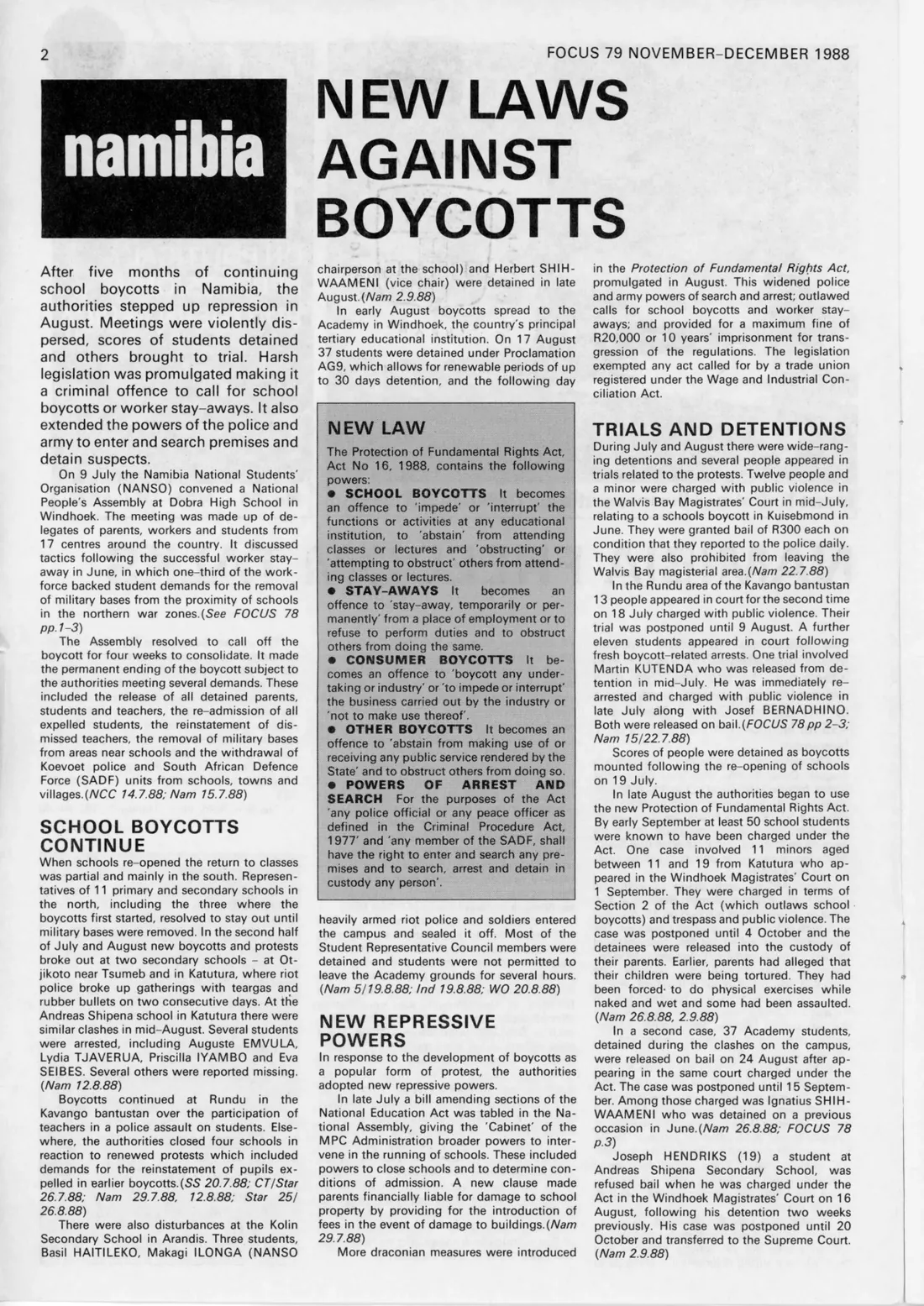
More draconian measures were introduced in the Protection of Fundamental Rights Act, promulgated in August. This widened police and army powers of search and arrest; outlawed calls for school boycotts and worker stay-aways; and provided for a maximum fine of R20,000 or 10 years' imprisonment for transgression of the regulations. The legislation exempted any act called for by a trade union registered under the Wage and Industrial Conciliation Act.
The Protection of Fundamental Rights Act, Act No 16, 1988, contains the following powers:
- SCHOOL BOYCOTTS It becomes an offence to 'impede' or 'interrupt' the functions or activities at any educational institution, to 'abstain' from attending classes or lectures and 'obstructing' or 'attempting to obstruct' others from attending classes or lectures.
- STAY-AWAYS It becomes an offence to 'stay-away, temporarily or permanently' from a place of employment or to refuse to perform duties and to obstruct others from doing the same.
- CONSUMER BOYCOTTS It becomes an offence to 'boycott any undertaking or industry' or 'to impede or interrupt' the business carried out by the industry or 'not to make use thereof'.
- OTHER BOYCOTTS It becomes an offence to 'abstain from making use of or receiving any public service rendered by the State' and to obstruct others from doing so.
- POWERS OF ARREST AND SEARCH For the purposes of the Act 'any police official or any peace officer as defined in the Criminal Procedure Act, 1977' and 'any member of the SADF, shall have the right to enter and search any premises and to search, arrest and detain in custody any person'.