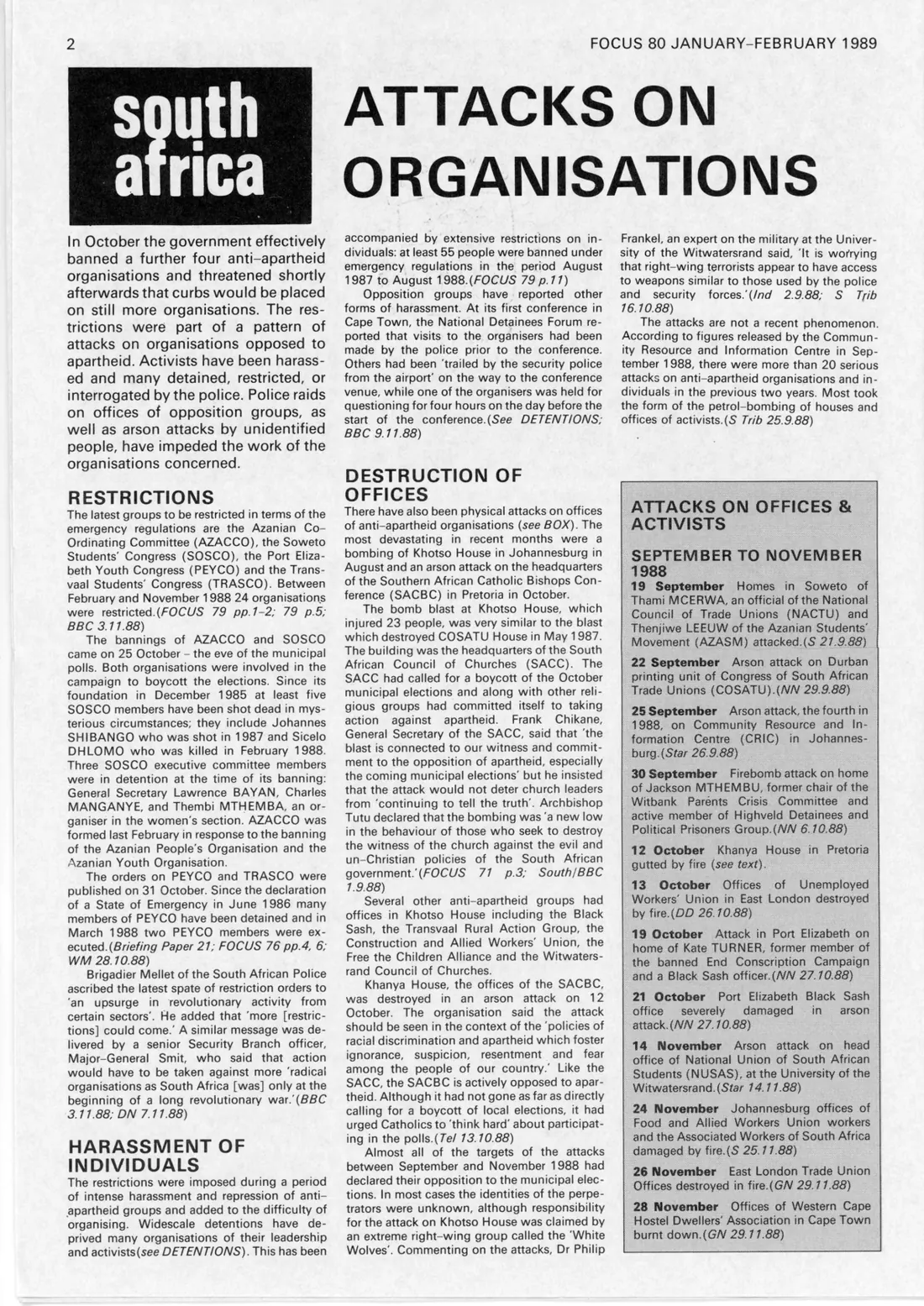
In October the government effectively banned a further four anti-apartheid organisations and threatened shortly afterwards that curbs would be placed on still more organisations. The restrictions were part of a pattern of attacks on organisations opposed to apartheid. Activists have been harassed and many detained, restricted, or interrogated by the police. Police raids on offices of opposition groups, as well as arson attacks by unidentified people, have impeded the work of the organisations concerned.
The latest groups to be restricted in terms of the emergency regulations are the Azanian Co-Ordinating Committee (AZACCO), the Soweto Students' Congress (SOSCO), the Port Elizabeth Youth Congress (PEYCO) and the Transvaal Students' Congress (TRASCO). Between February and November 1988 24 organisations were restricted.
The bannings of AZACCO and SOSCO came on 25 October – the eve of the municipal polls. Both organisations were involved in the campaign to boycott the elections. Since its foundation in December 1985 at least five SOSCO members have been shot dead in mysterious circumstances; they include Johannes SHIBANGO who was shot in 1987 and Sicelo DHLOMO who was killed in February 1988. Three SOSCO executive committee members were in detention at the time of its banning: General Secretary Lawrence BAYAN, Charles MANGANYE, and Thembi MTHEMBA, an organiser in the women's section. AZACCO was formed last February in response to the banning of the Azanian People's Organisation and the Azanian Youth Organisation.
The orders on PEYCO and TRASCO were published on 31 October. Since the declaration of a State of Emergency in June 1986 many members of PEYCO have been detained and in March 1988 two PEYCO members were executed.
Brigadier Mellet of the South African Police ascribed the latest spate of restriction orders to 'an upsurge in revolutionary activity from certain sectors'. He added that 'more [restrictions] could come.' A similar message was delivered by a senior Security Branch officer, Major-General Smit, who said that action would have to be taken against more 'radical organisations as South Africa [was] only at the beginning of a long revolutionary war.'
The restrictions were imposed during a period of intense harassment and repression of anti-apartheid groups and added to the difficulty of organising. Widescale detentions have deprived many organisations of their leadership and activists. This has been accompanied by extensive restrictions on individuals: at least 55 people were banned under emergency regulations in the period August 1987 to August 1988.
Opposition groups have reported other forms of harassment. At its first conference in Cape Town, the National Detainees Forum reported that visits to the organisers had been made by the police prior to the conference. Others had been 'trailed by the security police from the airport' on the way to the conference venue, while one of the organisers was held for questioning for four hours on the day before the start of the conference.
There have also been physical attacks on offices of anti-apartheid organisations. The most devastating in recent months were a bombing of Khotso House in Johannesburg in August and an arson attack on the headquarters of the Southern African Catholic Bishops Conference (SACBC) in Pretoria in October.
The bomb blast at Khotso House, which injured 23 people, was very similar to the blast which destroyed COSATU House in May 1987. The building was the headquarters of the South African Council of Churches (SACC). The SACC had called for a boycott of the October municipal elections and along with other religious groups had committed itself to taking action against apartheid. Frank Chikane, General Secretary of the SACC, said that 'the blast is connected to our witness and commitment to the opposition of apartheid, especially the coming municipal elections' but he insisted that the attack would not deter church leaders from 'continuing to tell the truth'. Archbishop Tutu declared that the bombing was 'a new low in the behaviour of those who seek to destroy the witness of the church against the evil and un-Christian policies of the South African government.'
Several other anti-apartheid groups had offices in Khotso House including the Black Sash, the Transvaal Rural Action Group, the Construction and Allied Workers' Union, the Free the Children Alliance and the Witwatersrand Council of Churches.
Khanya House, the offices of the SACBC, was destroyed in an arson attack on 12 October. The organisation said the attack should be seen in the context of the 'policies of racial discrimination and apartheid which foster ignorance, suspicion, resentment and fear among the people of our country.' Like the SACC, the SACBC is actively opposed to apartheid. Although it had not gone as far as directly calling for a boycott of local elections, it had urged Catholics to 'think hard' about participating in the polls.
Almost all of the targets of the attacks between September and November 1988 had declared their opposition to the municipal elections. In most cases the identities of the perpetrators were unknown, although responsibility for the attack on Khotso House was claimed by an extreme right-wing group called the 'White Wolves'. Commenting on the attacks, Dr Philip Frankel, an expert on the military at the University of the Witwatersrand said, 'It is worrying that right-wing terrorists appear to have access to weapons similar to those used by the police and security forces.'
The attacks are not a recent phenomenon. According to figures released by the Community Resource and Information Centre in September 1988, there were more than 20 serious attacks on anti-apartheid organisations and individuals in the previous two years. Most took the form of the petrol-bombing of houses and offices of activists.