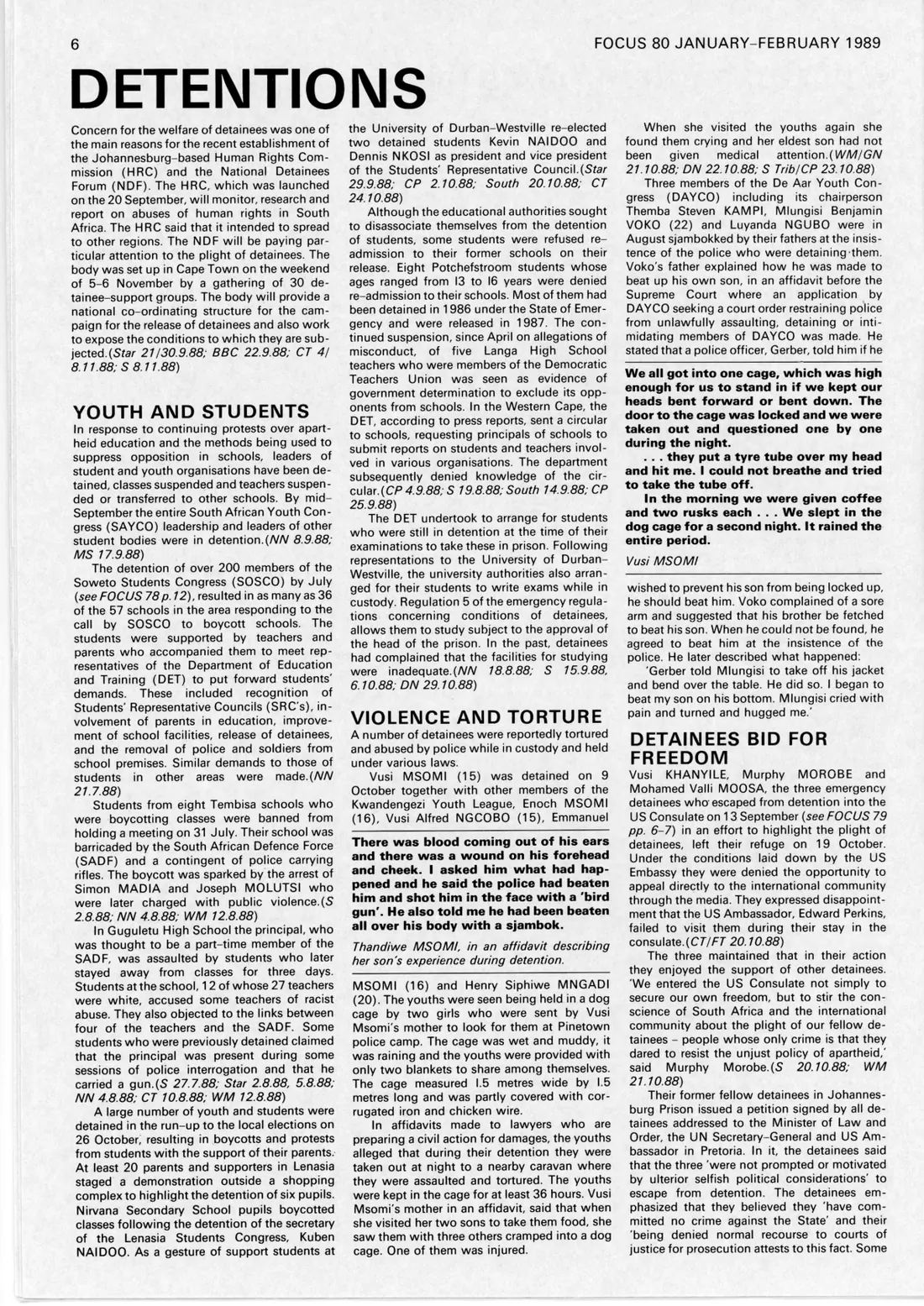
Concern for the welfare of detainees was one of the main reasons for the recent establishment of the Johannesburg-based Human Rights Commission (HRC) and the National Detainees Commission (NDF). The HRC, which was launched on the 20 September, will monitor, research and report on abuses of human rights in South Africa. The HRC said that it intended to spread to other regions. The NDF will be paying particular attention to the plight of detainees. The body was set up in Cape Town on the weekend of 5-6 November by a gathering of 30 detainee-support groups. The body will provide a national co-ordinating structure for the campaign for the release of detainees and also work to expose the conditions to which they are subjected.
In response to continuing protests over apartheid education and the methods being used to suppress opposition in schools, leaders of student and youth organisations have been detained, classes suspended and teachers suspended or transferred to other schools. By mid-September the entire South African Youth Congress (SAYCO) leadership and leaders of other student bodies were in detention.
The detention of over 200 members of the Soweto Students Congress (SOSCO) by July, resulted in as many as 36 of the 57 schools in the area responding to the call by SOSCO to boycott schools. The students were supported by teachers and parents who accompanied them to meet representatives of the Department of Education and Training (DET) to put forward students' demands. These included recognition of Students' Representative Councils (SRC's), involvement of parents in education, improvement of school facilities, release of detainees, and the removal of police and soldiers from school premises. Similar demands to those of students in other areas were made.
Students from eight Tembisa schools who were boycotting classes were banned from holding a meeting on 31 July. Their school was barricaded by the South African Defence Force (SADF) and a contingent of police carrying rifles. The boycott was sparked by the arrest of Simon MADIA and Joseph MOLUTSI who were later charged with public violence.
In Guguletu High School the principal, who was thought to be a part-time member of the SADF, was assaulted by students who later stayed away from classes for three days. Students at the school, 12 of whose 27 teachers were white, accused some teachers of racist abuse. They also objected to the links between four of the teachers and the SADF. Some students who were previously detained claimed that the principal was present during some sessions of police interrogation and that he carried a gun.
A large number of youth and students were detained in the run-up to the local elections on 26 October, resulting in boycotts and protests from students with the support of their parents. At least 20 parents and supporters in Lenasia staged a demonstration outside a shopping complex to highlight the detention of six pupils. Nirvana Secondary School pupils boycotted classes following the detention of the secretary of the Lenasia Students Congress, Kuben NAIDOO. As a gesture of support students at the University of Durban-Westville re-elected two detained students Kevin NAIDOO and Dennis NKOSI as president and vice president of the Students' Representative Council.
Although the educational authorities sought to disassociate themselves from the detention of students, some students were refused re-admission to their former schools on their release. Eight Potchefstroom students whose ages ranged from 13 to 16 years were denied re-admission to their schools. Most of them had been detained in 1986 under the State of Emergency and were released in 1987. The continued suspension, since April on allegations of misconduct, of five Langa High School teachers who were members of the Democratic Teachers Union was seen as evidence of government determination to exclude its opponents from schools. In the Western Cape, the DET, according to press reports, sent a circular to schools, requesting principals of schools to submit reports on students and teachers involved in various organisations. The department subsequently denied knowledge of the circular.
The DET undertook to arrange for students who were still in detention at the time of their examinations to take these in prison. Following representations to the University of Durban-Westville, the university authorities also arranged for their students to write exams while in custody. Regulation 5 of the emergency regulations concerning conditions of detainees, allows them to study subject to the approval of the head of the prison. In the past, detainees had complained that the facilities for studying were inadequate.
A number of detainees were reportedly tortured and abused by police while in custody and held under various laws.
Vusi MSOMI (15) was detained on 9 October together with other members of the Kwandengezi Youth League, Enoch MSOMI (16), Vusi Alfred NGCOBO (15), Emmanuel MSOMI (16) and Henry Siphiwe MNGADI (20). The youths were seen being held in a dog cage by two girls who were sent by Vusi Msomi's mother to look for them at Pinetown police camp. The cage was wet and muddy, it was raining and the youths were provided with only two blankets to share among themselves. The cage measured 1.5 metres wide by 1.5 metres long and was partly covered with corrugated iron and chicken wire.
In affidavits made to lawyers who are preparing a civil action for damages, the youths alleged that during their detention they were taken out at night to a nearby caravan where they were assaulted and tortured. The youths were kept in the cage for at least 36 hours. Vusi Msomi's mother in an affidavit, said that when she visited her two sons to take them food, she saw them with three others cramped into a dog cage. One of them was injured.
When she visited the youths again she found them crying and her eldest son had not been given medical attention.
Three members of the De Aar Youth Congress (DAYCO) including its chairperson Themba Steven KAMPI, Mlungisi Benjamin VOKO (22) and Luyanda NGUBO were in August sjambokked by their fathers at the insistence of the police who were detaining them. Voko's father explained how he was made to beat up his own son, in an affidavit before the Supreme Court where an application by DAYCO seeking a court order restraining police from unlawfully assaulting, detaining or intimidating members of DAYCO was made. He stated that a police officer, Gerber, told him if he wished to prevent his son from being locked up, he should beat him. Voko complained of a sore arm and suggested that his brother be fetched to beat his son. When he could not be found, he agreed to beat him at the insistence of the police. He later described what happened:
'Gerber told Mlungisi to take off his jacket and bend over the table. He did so. I began to beat my son on his bottom. Mlungisi cried with pain and turned and hugged me.'
Vusi KHANYILE, Murphy MOROBE and Mohamed Valli MOOSA, the three emergency detainees who escaped from detention into the US Consulate on 13 September in an effort to highlight the plight of detainees, left their refuge on 19 October. Under the conditions laid down by the US Embassy they were denied the opportunity to appeal directly to the international community through the media. They expressed disappointment that the US Ambassador, Edward Perkins, failed to visit them during their stay in the consulate.
The three maintained that in their action they enjoyed the support of other detainees. 'We entered the US Consulate not simply to secure our own freedom, but to stir the conscience of South Africa and the international community about the plight of our fellow detainees - people whose only crime is that they dared to resist the unjust policy of apartheid,' said Murphy Morobe.
Their former fellow detainees in Johannesburg Prison issued a petition signed by all detainees addressed to the Minister of Law and Order, the UN Secretary-General and US Ambassador in Pretoria. In it, the detainees said that the three 'were not prompted or motivated by ulterior selfish political considerations' to escape from detention. The detainees emphasized that they believed they 'have committed no crime against the State' and their 'being denied normal recourse to courts of justice for prosecution attests to this fact. Some of us have now been here for periods extending well over two years, this marking an unprecedented prolonged detention period in South Africa's legal history.
At Vereeniging Prison, an 11-day hunger strike by eight emergency detainees forced the prison authorities to negotiate with the detainees over their demands. The hunger strike followed two memoranda sent to the prison authorities which brought no response. Three of the detainees were released unconditionally, one was charged and freed on bail. However, four others remained in detention. On 24 October, detainees in Pollsmoor Prison went on a two-day hunger strike in protest at the bad prison conditions while in Victor Verster Prison, in Paarl, detainees went on hunger strike in protest against the October elections.