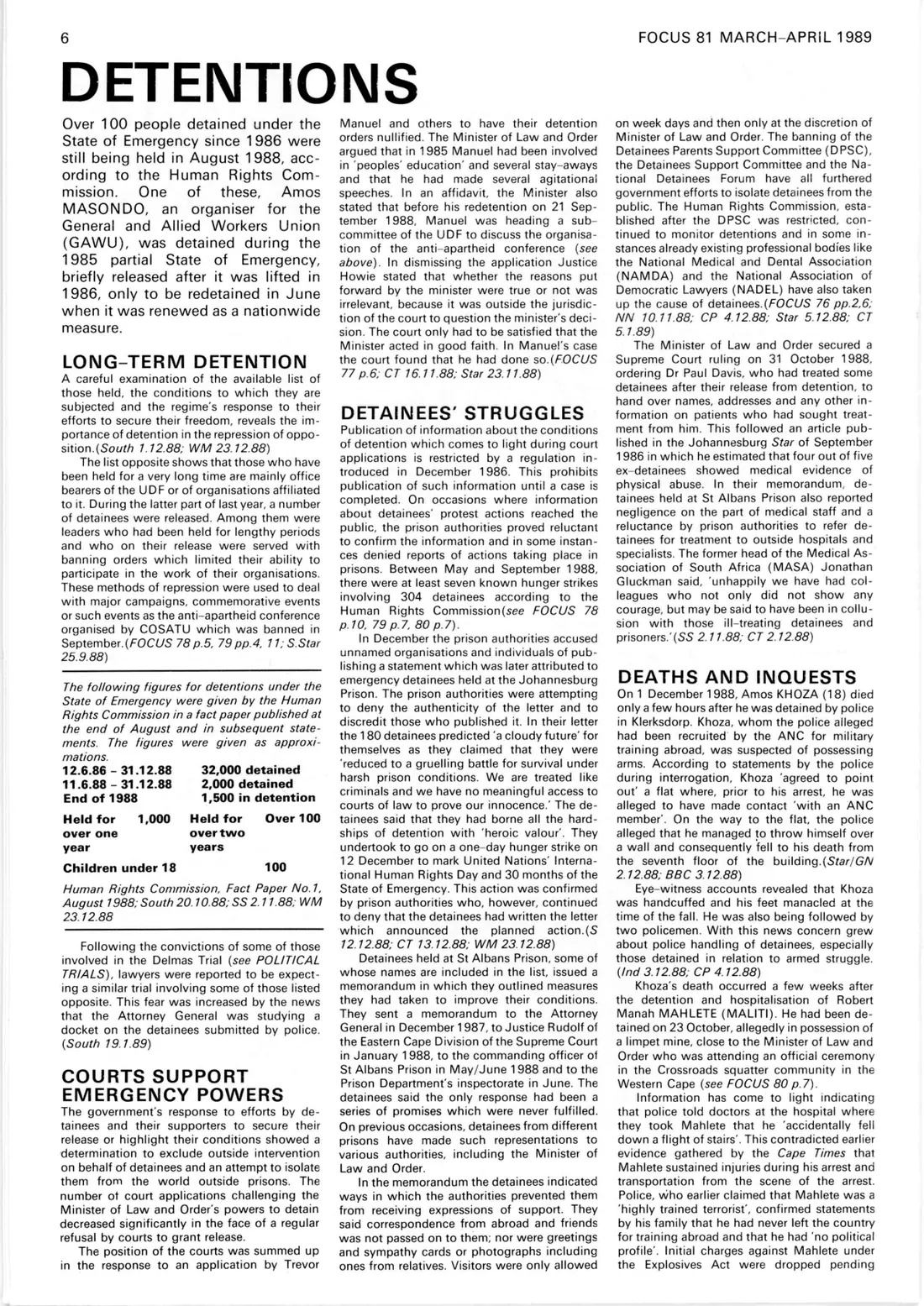
Over 100 people detained under the State of Emergency since 1986 were still being held in August 1988, according to the Human Rights Commission. One of these, Amos MASONDO, an organiser for the General and Allied Workers Union (GAWU), was detained during the 1985 partial State of Emergency, briefly released after it was lifted in 1986, only to be redetained in June when it was renewed as a nationwide measure.
LONG-TERM DETENTION
A careful examination of the available list of those held, the conditions to which they are subjected and the regime's response to their efforts to secure their freedom, reveals the importance of detention in the repression of opposition.
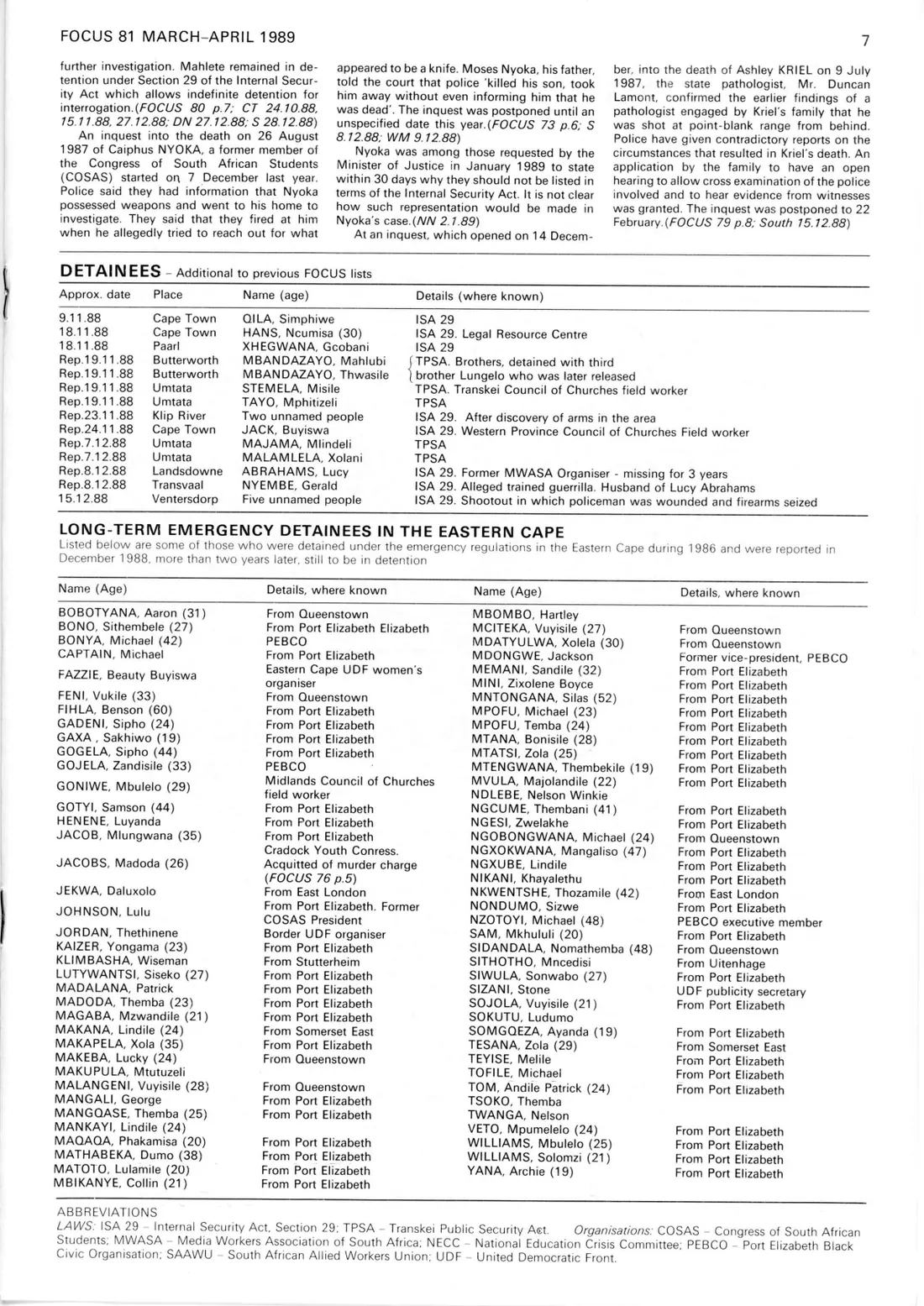
The list opposite shows that those who have been held for a very long time are mainly office bearers of the UDF or of organisations affiliated to it. During the latter part of last year, a number of detainees were released. Among them were leaders who had been held for lengthy periods and who on their release were served with banning orders which limited their ability to participate in the work of their organisations. These methods of repression were used to deal with major campaigns, commemorative events or such events as the anti-apartheid conference organised by COSATU which was banned in September.
The following figures for detentions under the State of Emergency were given by the Human Rights Commission in a fact paper published at the end of August and in subsequent statements. The figures were given as approximations.
Following the convictions of some of those involved in the Delmas Trial (see POLITICAL TRIALS), lawyers were reported to be expecting a similar trial involving some of those listed opposite. This fear was increased by the news that the Attorney General was studying a docket on the detainees submitted by police.
COURTS SUPPORT EMERGENCY POWERS
The government's response to efforts by detainees and their supporters to secure their release or highlight their conditions showed a determination to exclude outside intervention on behalf of detainees and an attempt to isolate them from the world outside prisons. The number of court applications challenging the Minister of Law and Order's powers to detain decreased significantly in the face of a regular refusal by courts to grant release.
The position of the courts was summed up in the response to an application by Trevor Manuel and others to have their detention orders nullified. The Minister of Law and Order argued that in 1985 Manuel had been involved in 'peoples' education' and several stay-aways and that he had made several agitational speeches. In an affidavit, the Minister also stated that before his redetention on 21 September 1988, Manuel was heading a sub-committee of the UDF to discuss the organisation of the anti-apartheid conference (see above). In dismissing the application Justice Howie stated that whether the reasons put forward by the minister were true or not was irrelevant, because it was outside the jurisdiction of the court to question the minister's decision. The court only had to be satisfied that the Minister acted in good faith. In Manuel's case the court found that he had done so.
DETAINES' STRUGGLES
Publication of information about the conditions of detention which comes to light during court applications is restricted by a regulation introduced in December 1986. This prohibits publication of such information until a case is completed. On occasions where information about detainees' protest actions reached the public, the prison authorities proved reluctant to confirm the information and in some instances denied reports of actions taking place in prisons. Between May and September 1988, there were at least seven known hunger strikes involving 304 detainees according to the Human Rights Commission.
In December the prison authorities accused unnamed organisations and individuals of publishing a statement which was later attributed to emergency detainees held at the Johannesburg Prison. The prison authorities were attempting to deny the authenticity of the letter and to discredit those who published it. In their letter the 180 detainees predicted 'a cloudy future' for themselves as they claimed that they were 'reduced to a gruelling battle for survival under harsh prison conditions. We are treated like criminals and we have no meaningful access to courts of law to prove our innocence.' The detainees said that they had borne all the hardships of detention with 'heroic valour'. They undertook to go on a one-day hunger strike on 12 December to mark United Nations' International Human Rights Day and 30 months of the State of Emergency. This action was confirmed by prison authorities who, however, continued to deny that the detainees had written the letter which announced the planned action.
Detainees held at St Albans Prison, some of whose names are included in the list, issued a memorandum in which they outlined measures they had taken to improve their conditions. They sent a memorandum to the Attorney General in December 1987, to Justice Rudolf of the Eastern Cape Division of the Supreme Court in January 1988, to the commanding officer of St Albans Prison in May/June 1988 and to the Prison Department's inspectorate in June. The detainees said the only response had been a series of promises which were never fulfilled. On previous occasions, detainees from different prisons have made such representations to various authorities, including the Minister of Law and Order.
In the memorandum the detainees indicated ways in which the authorities prevented them from receiving expressions of support. They said correspondence from abroad and friends was not passed on to them; nor were greetings and sympathy cards or photographs including ones from relatives. Visitors were only allowed on week days and then only at the discretion of Minister of Law and Order. The banning of the Detainees Parents Support Committee (DPSC), the Detainees Support Committee and the National Detainees Forum have all furthered government efforts to isolate detainees from the public. The Human Rights Commission, established after the DPSC was restricted, continued to monitor detentions and in some instances already existing professional bodies like the National Medical and Dental Association (NAMDA) and the National Association of Democratic Lawyers (NADEL) have also taken up the cause of detainees.
The Minister of Law and Order secured a Supreme Court ruling on 31 October 1988, ordering Dr Paul Davis, who had treated some detainees after their release from detention, to hand over names, addresses and any other information on patients who had sought treatment from him. This followed an article published in the Johannesburg Star of September 1986 in which he estimated that four out of five ex-detainees showed medical evidence of physical abuse. In their memorandum, detainees held at St Albans Prison also reported negligence on the part of medical staff and a reluctance by prison authorities to refer detainees for treatment to outside hospitals and specialists. The former head of the Medical Association of South Africa (MASA) Jonathan Gluckman said, 'unhappily we have had colleagues who not only did not show any courage, but may be said to have been in collusion with those ill-treating detainees and prisoners.'
DEATHS AND INQUESTS
On 1 December 1988, Amos KHOZA (18) died only a few hours after he was detained by police in Klerksdorp. Khoza, whom the police alleged had been recruited by the ANC for military training abroad, was suspected of possessing arms. According to statements by the police during interrogation, Khoza 'agreed to point out' a flat where, prior to his arrest, he was alleged to have made contact 'with an ANC member'. On the way to the flat, the police alleged that he managed to throw himself over a wall and consequently fell to his death from the seventh floor of the building.
Eye-witness accounts revealed that Khoza was handcuffed and his feet manacled at the time of the fall. He was also being followed by two policemen. With this news concern grew about police handling of detainees, especially those detained in relation to armed struggle.
Khoza's death occurred a few weeks after the detention and hospitalisation of Robert Manah MAHLETE (MALITI). He had been detained on 23 October, allegedly in possession of a limpet mine, close to the Minister of Law and Order who was attending an official ceremony in the Crossroads squatter community in the Western Cape.
Information has come to light indicating that police told doctors at the hospital where they took Mahlete that he 'accidentally fell down a flight of stairs'. This contradicted earlier evidence gathered by the Cape Times that Mahlete sustained injuries during his arrest and transportation from the scene of the arrest. Police, who earlier claimed that Mahlete was a 'highly trained terrorist', confirmed statements by his family that he had never left the country for training abroad and that he had 'no political profile'. Initial charges against Mahlete under the Explosives Act were dropped pending further investigation. Mahlete remained in detention under Section 29 of the Internal Security Act which allows indefinite detention for interrogation.
An inquest into the death on 26 August 1987 of Caiphus NYOKA, a former member of the Congress of South African Students (COSAS) started on 7 December last year. Police said they had information that Nyoka possessed weapons and went to his home to investigate. They said that they fired at him when he allegedly tried to reach out for what appeared to be a knife. Moses Nyoka, his father, told the court that police 'killed his son, took him away without even informing him that he was dead'. The inquest was postponed until an unspecified date this year.
Nyoka was among those requested by the Minister of Justice in January 1989 to state within 30 days why they should not be listed in terms of the Internal Security Act. It is not clear how such representation would be made in Nyoka's case.
At an inquest, which opened on 14 December, into the death of Ashley KRIEL on 9 July 1987, the state pathologist, Mr. Duncan Lamont, confirmed the earlier findings of a pathologist engaged by Kriel's family that he was shot at point-blank range from behind. Police have given contradictory reports on the circumstances that resulted in Kriel's death. An application by the family to have an open hearing to allow cross examination of the police involved and to hear evidence from witnesses was granted. The inquest was postponed to 22 February.