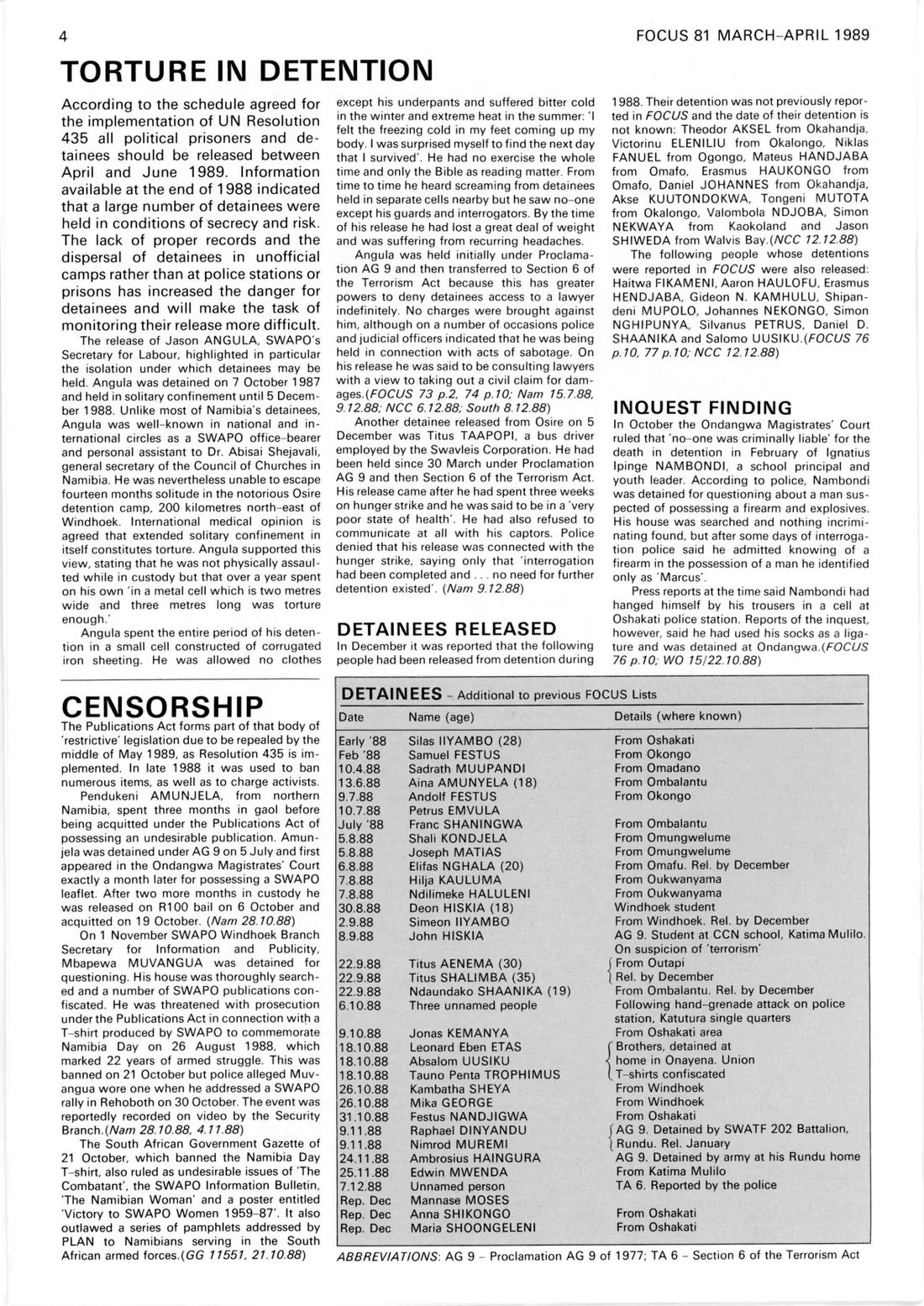
According to the schedule agreed for the implementation of UN Resolution 435 all political prisoners and detainees should be released between April and June 1989. Information available at the end of 1988 indicated that a large number of detainees were held in conditions of secrecy and risk. The lack of proper records and the dispersal of detainees in unofficial camps rather than at police stations or prisons has increased the danger for detainees and will make the task of monitoring their release more difficult.
The release of Jason ANGULA, SWAPO's Secretary for Labour, highlighted in particular the isolation under which detainees may be held. Angula was detained on 7 October 1987 and held in solitary confinement until 5 December 1988. Unlike most of Namibia's detainees, Angula was well-known in national and international circles as a SWAPO office-bearer and personal assistant to Dr. Abisai Shejavali, general secretary of the Council of Churches in Namibia. He was nevertheless unable to escape fourteen months solitude in the notorious Osire detention camp, 200 kilometres north-east of Windhoek. International medical opinion is agreed that extended solitary confinement in itself constitutes torture. Angula supported this view, stating that he was not physically assaulted while in custody but that over a year spent on his own 'in a metal cell which is two metres wide and three metres long was torture enough.'
Angula spent the entire period of his detention in a small cell constructed of corrugated iron sheeting. He was allowed no clothes except his underpants and suffered bitter cold in the winter and extreme heat in the summer: 'I felt the freezing cold in my feet coming up my body. I was surprised myself to find the next day that I survived'. He had no exercise the whole time and only the Bible as reading matter. From time to time he heard screaming from detainees held in separate cells nearby but he saw no-one except his guards and interrogators. By the time of his release he had lost a great deal of weight and was suffering from recurring headaches.
Angula was held initially under Proclamation AG 9 and then transferred to Section 6 of the Terrorism Act because this has greater powers to deny detainees access to a lawyer indefinitely. No charges were brought against him, although on a number of occasions police and judicial officers indicated that he was being held in connection with acts of sabotage. On his release he was said to be consulting lawyers with a view to taking out a civil claim for damages.
Another detainee released from Osire on 5 December was Titus TAAPOPI, a bus driver employed by the Swavleis Corporation. He had been held since 30 March under Proclamation AG 9 and then Section 6 of the Terrorism Act. His release came after he had spent three weeks on hunger strike and he was said to be in a 'very poor state of health'. He had also refused to communicate at all with his captors. Police denied that his release was connected with the hunger strike, saying only that 'interrogation had been completed and ... no need for further detention existed'.
DETAINES RELEASED
In December it was reported that the following people had been released from detention during 1988. Their detention was not previously reported in FOCUS and the date of their detention is not known: Theodor AKSEL from Okahandja, Victorinu ELENILIU from Okalongo, Niklas FANUEL from Ogongo, Mateus HANDJABA from Omafo, Erasmus HAUKONGO from Omafo, Daniel JOHANNES from Okahandja, Akse KUUTONDOKWA, Tongeni MUTOTA from Okalongo, Valombola NDJOBA, Simon NEKWAYA from Kaokoland and Jason SHIWEDA from Walvis Bay.
The following people whose detentions were reported in FOCUS were also released: Haitwa FIKAMENI, Aaron HAULOFU, Erasmus HENDJABA, Gideon N. KAMHULU, Shipanden MUPOLO, Johannes NEKONGO, Simon NGHIPUNYA, Silvanus PETRUS, Daniel D. SHAANIKA and Salomo UUSIKU.
INQUEST FINDING
In October the Ondangwa Magistrates' Court ruled that 'no-one was criminally liable' for the death in detention in February of Ignatius Ipinge NAMBONDI, a school principal and youth leader. According to police, Nambondi was detained for questioning about a man suspected of possessing a firearm and explosives. His house was searched and nothing incriminating found, but after some days of interrogation police said he admitted knowing of a firearm in the possession of a man he identified only as 'Marcus'.
Press reports at the time said Nambondi had hanged himself by his trousers in a cell at Oshakati police station. Reports of the inquest, however, said he had used his socks as a ligature and was detained at Ondangwa.
CENSORSHIP
The Publications Act forms part of that body of 'restrictive' legislation due to be repealed by the middle of May 1989, as Resolution 435 is implemented. In late 1988 it was used to ban numerous items, as well as to charge activists.
Pendukeni AMUNJELA, from northern Namibia, spent three months in gaol before being acquitted under the Publications Act of possessing an undesirable publication. Amunjela was detained under AG 9 on 5 July and first appeared in the Ondangwa Magistrates' Court exactly a month later for possessing a SWAPO leaflet. After two more months in custody he was released on R100 bail on 6 October and acquitted on 19 October.
On 1 November SWAPO Windhoek Branch Secretary for Information and Publicity, Mbapewa MUVANGUA was detained for questioning. His house was thoroughly searched and a number of SWAPO publications confiscated. He was threatened with prosecution under the Publications Act in connection with a T-shirt produced by SWAPO to commemorate Namibia Day on 26 August 1988, which marked 22 years of armed struggle. This was banned on 21 October but police alleged Muvangua wore one when he addressed a SWAPO rally in Rehoboth on 30 October. The event was reportedly recorded on video by the Security Branch.
The South African Government Gazette of 21 October, which banned the Namibia Day T-shirt, also ruled as undesirable issues of 'The Combatant', the SWAPO Information Bulletin, 'The Namibian Woman' and a poster entitled 'Victory to SWAPO Women 1959-87'. It also outlawed a series of pamphlets addressed by PLAN to Namibians serving in the South African armed forces.