Election threat SWAPO has also expressed concern that the AG may introduce regulations which make it difficult for exiles and refugees to return and to vote. The liberation movement has asked the UN High Commissioner for Refugees (UNHCR) to return to Namibia between 41,000 and 42,000 of the 74,000 registered refugees in Angola and Zambia — those remaining behind will be mainly young people not eligible to vote.
The UNHCR approached the Council of Churches in Namibia to oversee refugee resettlement and welfare, but the South African authorities have attempted to set up their own refugee resettlement camps at army bases and in UNITA-controlled areas of northern Namibia.
Campaigning Political groups opposed to SWAPO used the period before the arrival of the main body of UN forces on 1 April to prepare for the election campaign. New and often shaky alliances were forged as small groups sought to maximise their vote under the proportional representation system. By the end of February one alliance was reported to have 93 million rand in its campaign coffers — about 150 rand for each voter, according to South African estimates of the electoral roll. Another alliance was reported to have raised 56 million rand. It was not clear how much of this money had come from South Africa, but in past elections, such as the South African-controlled elections of 1978, large amounts of money were transferred to anti-SWAPO parties from South Africa.
Civil servants and most government officials, including those employed by the apartheid second-tier authorities, will continue to carry out their functions on government pay during the election period. Patronage, bribery and corruption have been rife in the civil service.
South African-appointed officials and existing local authorities will continue to administer local regulations, thus giving them control over venues for meetings, display of posters and other aspects of the election campaign. South Africa will directly control Walvis Bay during the election period, and, unless repressive legislation such as the State of Emergency restrictions are repealed, registration, campaigning and voting in the enclave will be difficult.
Media The UN Special Representative is charged with ensuring that access to the media is free and fair for all parties. Almost all the daily and weekly newspapers in Namibia are funded and controlled by anti-SWAPO interests — many are directly controlled by South African-backed political groups. The only newspaper sympathetic to SWAPO, The Namibian, has been repeatedly attacked and its offices damaged by arson. TV and radio are directly controlled by the authorities and have an overwhelming anti-SWAPO bias.
SWAPO SWAPO has expressed concern about South Africa's attempts to inhibit a free and fair election, but has committed itself to winning a two-thirds majority in the Constituent Assembly, which will enable it to draw up an independence constitution. In February, the internal and external leadership of the movement was integrated through the election of seven key internal leaders to the externally-based Central Committee. 'We are going back as one big election machine' said Central Committee member Hage Geingob, adding that the South Africans would 'see an election campaign machine that they have never witnessed in Africa'.
By March several SWAPO rallies, seminars and strategy meetings had been held in various parts of Namibia, including a 6,000-strong public meeting in the coastal town of Swakopmund. The powerful National Union of Namibian Workers (NUNW), representing between 50,000 and 60,000 workers, declared that it would campaign for a SWAPO victory, although remaining autonomous. 'Only a SWAPO victory will facilitate the struggle for workers' rights', said Ben Ulenga, General Secretary of the Mineworkers Union of Namibia.
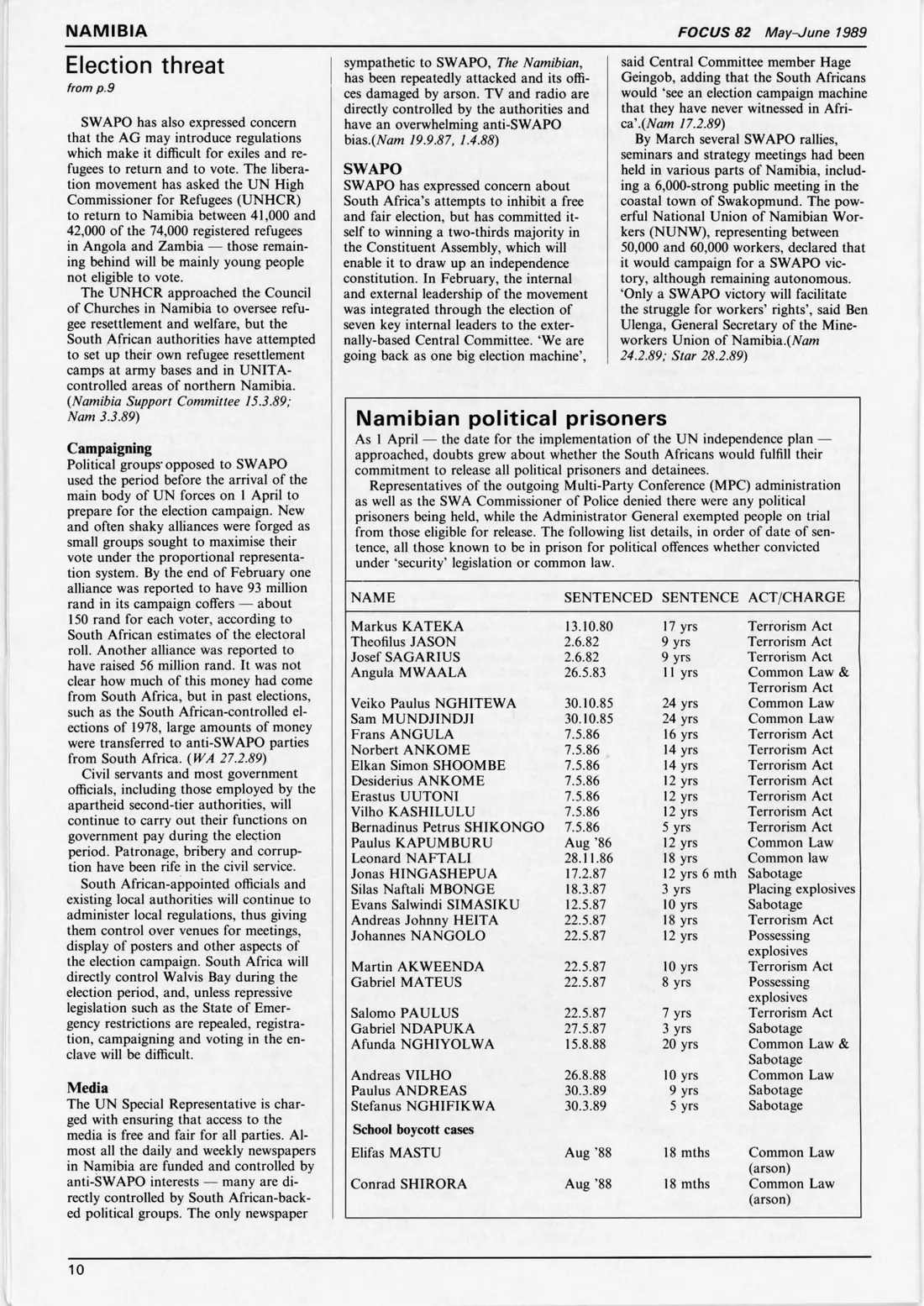
Namibian political prisoners As 1 April — the date for the implementation of the UN independence plan — approached, doubts grew about whether the South Africans would fulfill their commitment to release all political prisoners and detainees.
Representatives of the outgoing Multi-Party Conference (MPC) administration as well as the SWAPO Commissioner of Police denied there were any political prisoners being held, while the Administrator General exempted people on trial from those eligible for release. The following list details, in order of date of sentence, all those known to be in prison for political offences whether convicted under 'security' legislation or common law.
[Table of prisoners omitted]