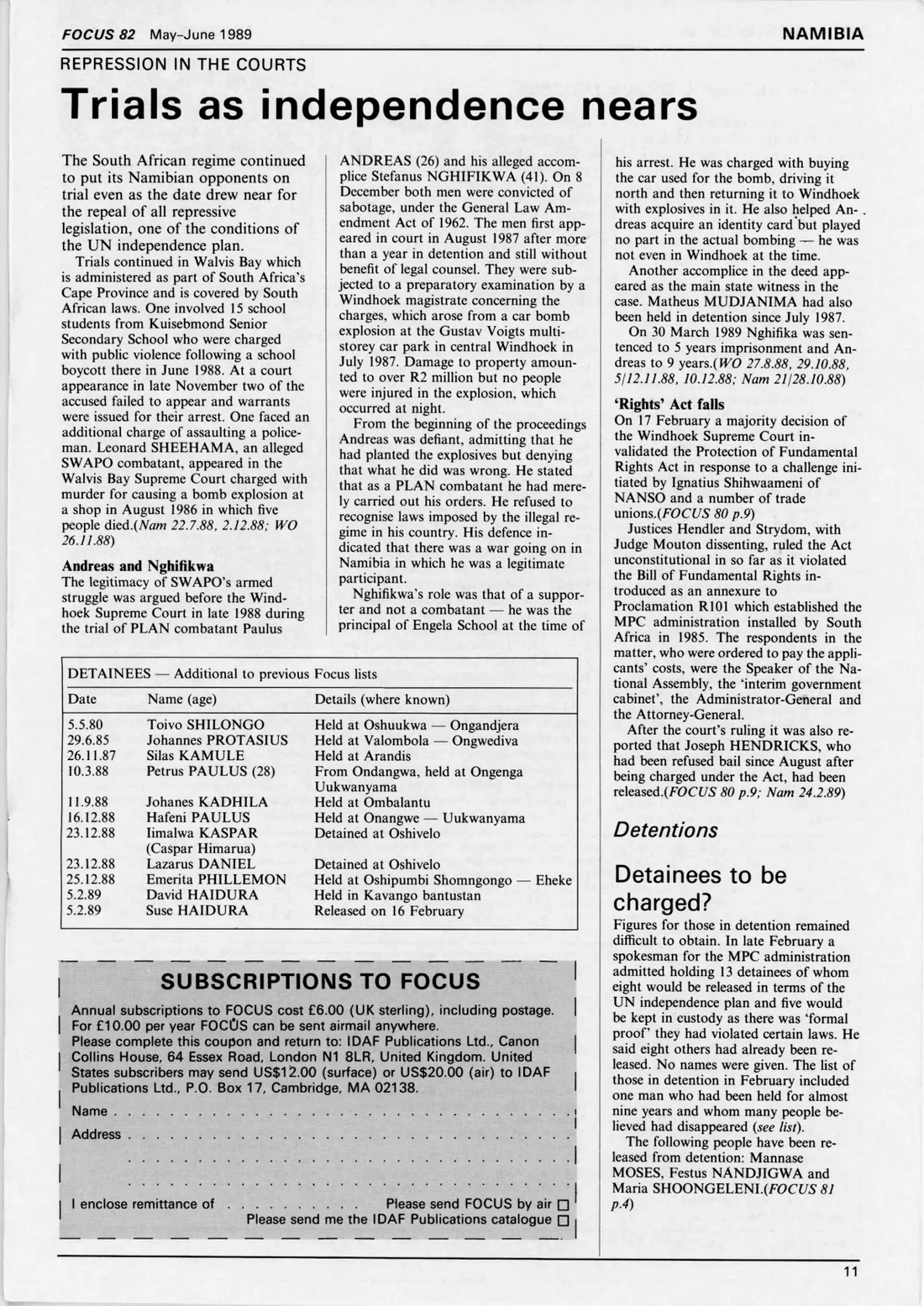
REPRESSION IN THE COURTS Trials as independence nears The South African regime continued to put its Namibian opponents on trial even as the date drew near for the repeal of all repressive legislation, one of the conditions of the UN independence plan.
Trials continued in Walvis Bay which is administered as part of South Africa's Cape Province and is covered by South African laws. One involved 15 school students from Kuisebmond Senior Secondary School who were charged with public violence following a school boycott there in June 1988. At a court appearance in late November two of the accused failed to appear and warrants were issued for their arrest. One faced an additional charge of assaulting a police-man. Leonard SHEEHAMA, an alleged SWAPO combatant, appeared in the Walvis Bay Supreme Court charged with murder for causing a bomb explosion at a shop in August 1986 in which five people died.
Andreas and Nghifikwa The legitimacy of SWAPO's armed struggle was argued before the Windhoek Supreme Court in late 1988 during the trial of PLAN combatant Paulus ANDREAS (26) and his alleged accomplice Stefanus NGHIFIKWA (41). On 8 December both men were convicted of sabotage, under the General Law Amendment Act of 1962. The men first appeared in court in August 1987 after more than a year in detention and still without benefit of legal counsel. They were subjected to a preparatory examination by a Windhoek magistrate concerning the charges, which arose from a car bomb explosion at the Gustav Voigts multi-storey car park in central Windhoek in July 1987. Damage to property amounted to over R2 million but no people were injured in the explosion, which occurred at night.
From the beginning of the proceedings Andreas was defiant, admitting that he had planted the explosives but denying that what he did was wrong. He stated that as a PLAN combatant he had merely carried out his orders. He refused to recognise laws imposed by the illegal regime in his country. His defence indicated that there was a war going on in Namibia in which he was a legitimate participant.
Nghifikwa's role was that of a supporter and not a combatant — he was the principal of Engela School at the time of his arrest. He was charged with buying the car used for the bomb, driving it north and then returning it to Windhoek with explosives in it. He also helped Andreas acquire an identity card but played no part in the actual bombing — he was not even in Windhoek at the time.
Another accomplice in the deed appeared as the main state witness in the case. Matheus MUDJANIMA had also been held in detention since July 1987.
On 30 March 1989 Nghifika was sentenced to 5 years imprisonment and Andreas to 9 years.
'Rights' Act falls On 17 February a majority decision of the Windhoek Supreme Court validated the Protection of Fundamental Rights Act in response to a challenge initiated by Ignatius Shihwaameni of NANSO and a number of trade unions. Justices Hendler and Strydom, with Judge Mouton dissenting, ruled the Act unconstitutional in so far as it violated the Bill of Fundamental Rights introduced as an annexure to Proclamation R101 which established the MPC administration installed by South Africa in 1985. The respondents in the matter, who were ordered to pay the applicants' costs, were the Speaker of the National Assembly, the 'interim government cabinet', the Administrator-General and the Attorney-General.
After the court's ruling it was also reported that Joseph HENDRICKS, who had been refused bail since August after being charged under the Act, had been released.
Detentions Detainees to be charged? Figures for those in detention remained difficult to obtain. In late February a spokesman for the MPC administration admitted holding 13 detainees of whom eight would be released in terms of the UN independence plan and five would be kept in custody as there was 'formal proof' they had violated certain laws. He said eight others had already been released. No names were given. The list of those in detention in February included one man who had been held for almost nine years and whom many people believed had disappeared.
The following people have been released from detention: Mannase MOSES, Festus NANDJIGWA and Maria SHOONGELENI.
[Table of detainees omitted]