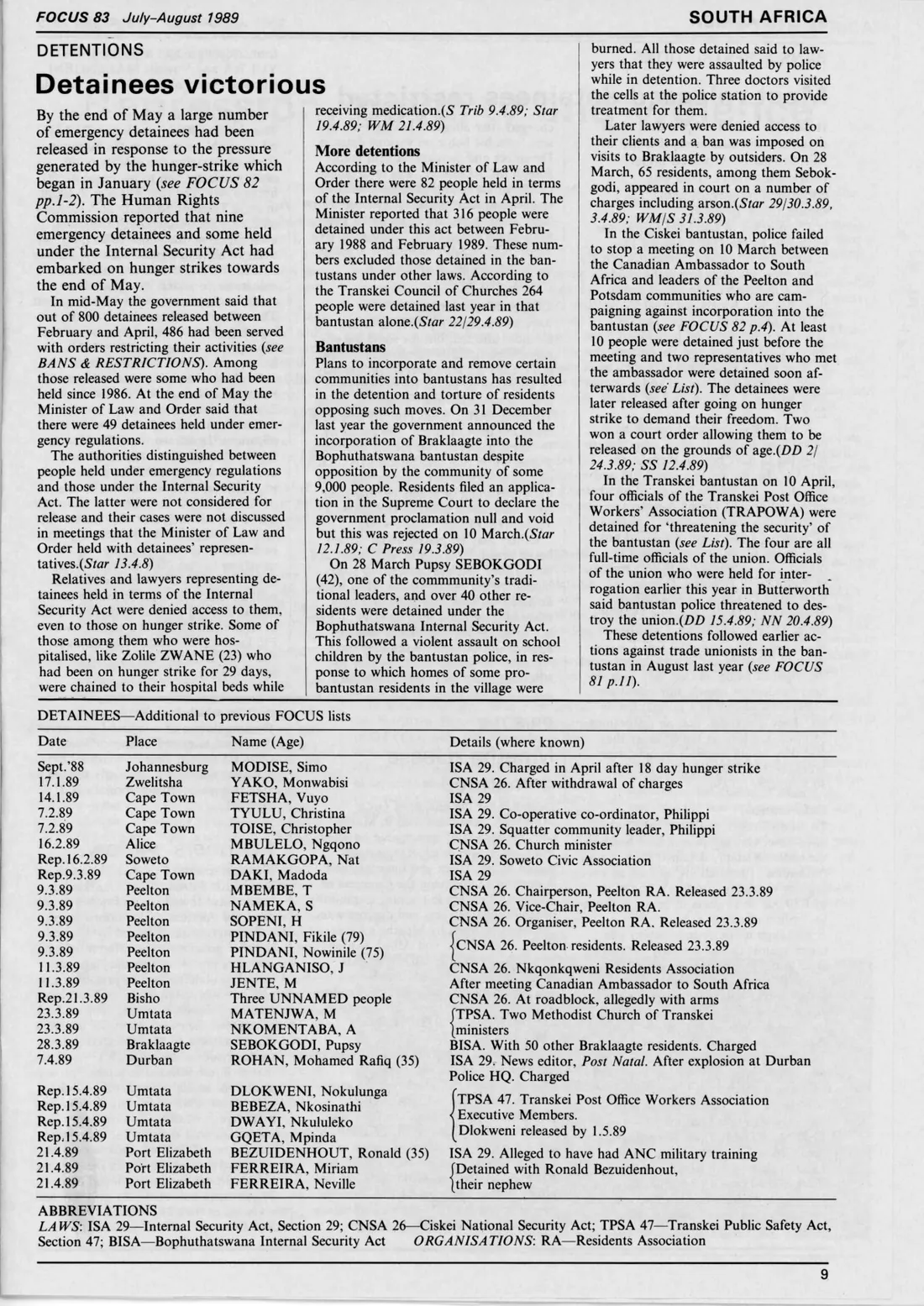
By the end of May a large number of emergency detainees had been released in response to the pressure generated by the hunger-strike which began in January (see FOCUS 82 pp.1-2). The Human Rights Commission reported that nine emergency detainees and some held under the Internal Security Act had embarked on hunger strikes towards the end of May.
In mid-May the government said that out of 800 detainees released between February and April, 486 had been served with orders restricting their activities (see BANS & RESTRICTIONS). Among those released were some who had been held since 1986. At the end of May the Minister of Law and Order said that there were 49 detainees held under emergency regulations.
The authorities distinguished between people held under emergency regulations and those under the Internal Security Act. The latter were not considered for release and their cases were not discussed in meetings that the Minister of Law and Order held with detainees' representatives.
Relatives and lawyers representing detainees held in terms of the Internal Security Act were denied access to them, even to those on hunger strike. Some of those among them who were hospitalised, like Zolile ZWANE (23) who had been on hunger strike for 29 days, were chained to their hospital beds while receiving medication.
More detentions According to the Minister of Law and Order there were 82 people held in terms of the Internal Security Act in April. The Minister reported that 316 people were detained under this act between February 1988 and February 1989. These numbers excluded those detained in the bantustans under other laws. According to the Transkei Council of Churches 264 people were detained last year in that bantustan alone.
Bantustans Plans to incorporate and remove certain communities into bantustans has resulted in the detention and torture of residents opposing such moves. On 31 December last year the government announced the incorporation of Braklaagte into the Bophuthatswana bantustan despite opposition by the community of some 9,000 people. Residents filed an application in the Supreme Court to declare the government proclamation null and void but this was rejected on 10 March.
On 28 March Pupsy SEBOKGODI (42), one of the community's traditional leaders, and over 40 other residents were detained under the Bophuthatswana Internal Security Act. This followed a violent assault on school children by the bantustan police, in response to which homes of some pro-bantustan residents in the village were burned. All those detained said to lawyers that they were assaulted by police while in detention. Three doctors visited the cells at the police station to provide treatment for them.
Later lawyers were denied access to their clients and a ban was imposed on visits to Braklaagte by outsiders. On 28 March, 65 residents, among them Sebokgodi, appeared in court on a number of charges including arson.
In the Ciskei bantustan, police failed to stop a meeting on 10 March between the Canadian Ambassador to South Africa and leaders of the Peelton and Potsdam communities who are campaigning against incorporation into the bantustan (see FOCUS 82 p.4). At least 10 people were detained just before the meeting and two representatives who met the ambassador were detained soon afterwards (see List). The detainees were later released after going on hunger strike to demand their freedom. Two won a court order allowing them to be released on the grounds of age.
In the Transkei bantustan on 10 April, four officials of the Transkei Post Office Workers' Association (TRAPOWA) were detained for 'threatening the security' of the bantustan (see List). The four are all full-time officials of the union. Officials of the union who were held for interrogation earlier this year in Butterworth said bantustan police threatened to destroy the union.
These detentions followed earlier actions against trade unionists in the bantustan in August last year (see FOCUS 81 p.11).