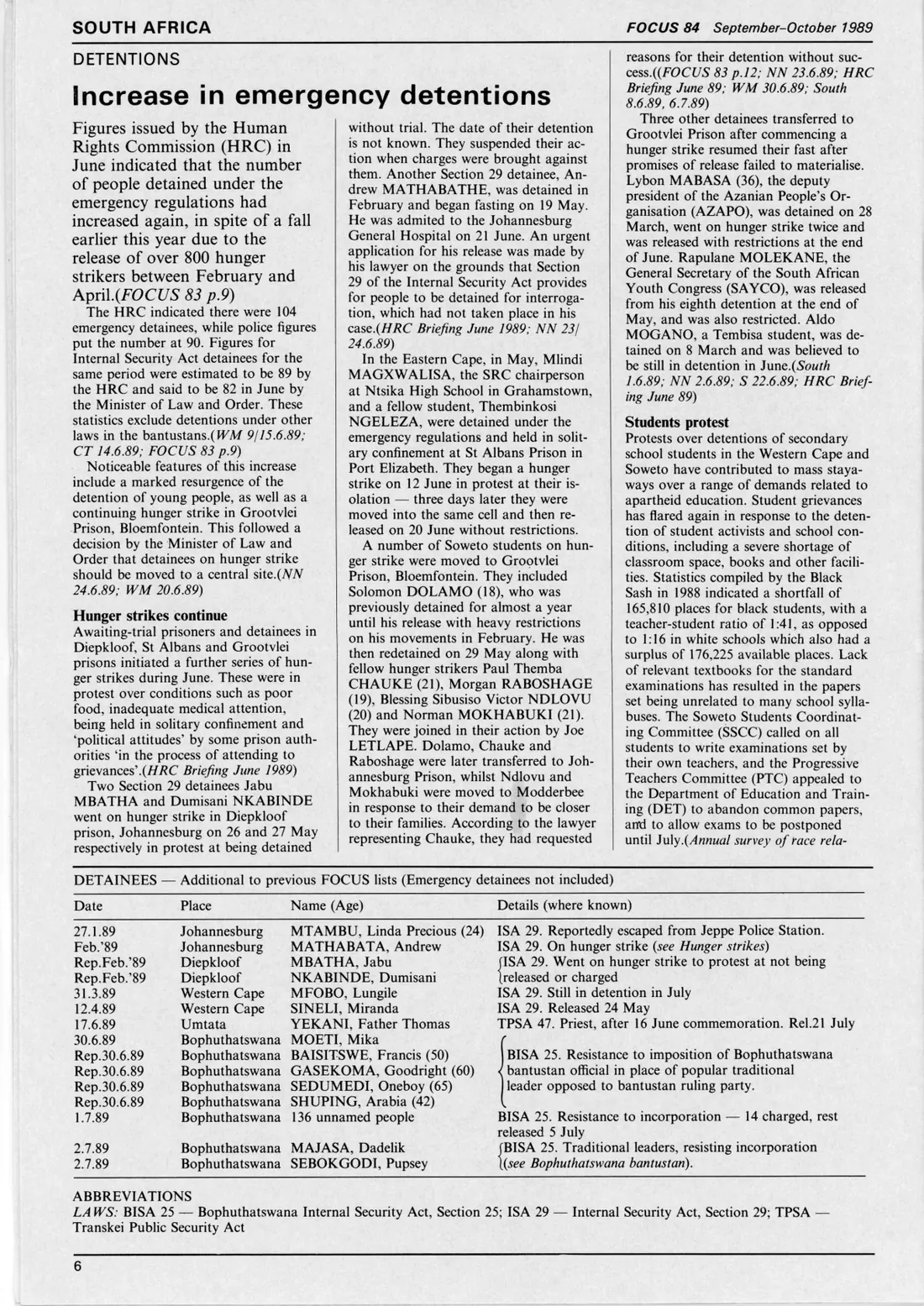
Figures issued by the Human Rights Commission (HRC) in June indicated that the number of people detained under the emergency regulations had increased again, in spite of a fall earlier this year due to the release of over 800 hunger strikers between February and April.
The HRC indicated there were 104 emergency detainees, while police figures put the number at 90. Figures for Internal Security Act detainees for the same period were estimated to be 89 by the HRC and said to be 82 in June by the Minister of Law and Order. These statistics exclude detentions under other laws in the bantustans.
Noticeable features of this increase include a marked resurgence of the detention of young people, as well as a continuing hunger strike in Grootvlei Prison, Bloemfontein. This followed a decision by the Minister of Law and Order that detainees on hunger strike should be moved to a central site.
Awaiting-trial prisoners and detainees in Diepkloof, St Albans and Grootvlei prisons initiated a further series of hunger strikes during June. These were in protest over conditions such as poor food, inadequate medical attention, being held in solitary confinement and 'political attitudes' by some prison authorities 'in the process of attending to grievances'.
Two Section 29 detainees Jabu MBATHA and Dumisani NKABINDE went on hunger strike in Diepkloof prison, Johannesburg on 26 and 27 May respectively in protest at being detained without trial. The date of their detention is not known. They suspended their action when charges were brought against them. Another Section 29 detainee, Andrew MATHABATHE, was detained in February and began fasting on 19 May. He was admitted to the Johannesburg General Hospital on 21 June. An urgent application for his release was made by his lawyer on the grounds that Section 29 of the Internal Security Act provides for people to be detained for interrogation, which had not taken place in his case.
In the Eastern Cape, in May, Mlindi MAGXWALISA, the SRC chairperson at Ntsika High School in Grahamstown, and a fellow student, Thembinkosi NGELEZA, were detained under the emergency regulations and held in solitary confinement at St Albans Prison in Port Elizabeth. They began a hunger strike on 12 June in protest at their isolation — three days later they were moved into the same cell and then released on 20 June without restrictions.
A number of Soweto students on hunger strike were moved to Grootvlei Prison, Bloemfontein. They included Solomon DOLAMO (18), who was previously detained for almost a year until his release with heavy restrictions on his movements in February. He was then redetained on 29 May along with fellow hunger strikers Paul Themba CHAUKE (21), Morgan RABOSHAGE (19), Blessing Sibusiso Victor NDLOVU (20) and Norman MOKHABUKI (21). They were joined in their action by Joe LETLAPE. Dolamo, Chauke and Raboshage were later transferred to Johannesburg Prison, whilst Ndlovu and Mokhabuki were moved to Modderbee in response to their demand to be closer to their families. According to the lawyer representing Chauke, they had requested reasons for their detention without success.
Three other detainees transferred to Grootvlei Prison after commencing a hunger strike resumed their fast after promises of release failed to materialise. Lybon MABASA (36), the deputy president of the Azanian People's Organisation (AZAPO), was detained on 28 March, went on hunger strike twice and was released with restrictions at the end of June. Rapulane MOLEKANE, the General Secretary of the South African Youth Congress (SAYCO), was released from his eighth detention at the end of May, and was also restricted. Aldo MOGANO, a Tembisa student, was detained on 8 March and was believed to be still in detention in June.
Protests over detentions of secondary school students in the Western Cape and Soweto have contributed to mass stayaways over a range of demands related to apartheid education. Student grievances has flared again in response to the detention of student activists and school conditions, including a severe shortage of classroom space, books and other facilities. Statistics compiled by the Black Sash in 1988 indicated a shortfall of 165,810 places for black students, with a teacher-student ratio of 1:41, as opposed to 1:16 in white schools which also had a surplus of 176,225 available places. Lack of relevant textbooks for the standard examinations has resulted in the papers set being unrelated to many school syllabuses. The Soweto Students Coordinating Committee (SSCC) called on all students to write examinations set by their own teachers, and the Progressive Teachers Committee (PTC) appealed to the Department of Education and Training (DET) to abandon common papers, and to allow exams to be postponed until July.