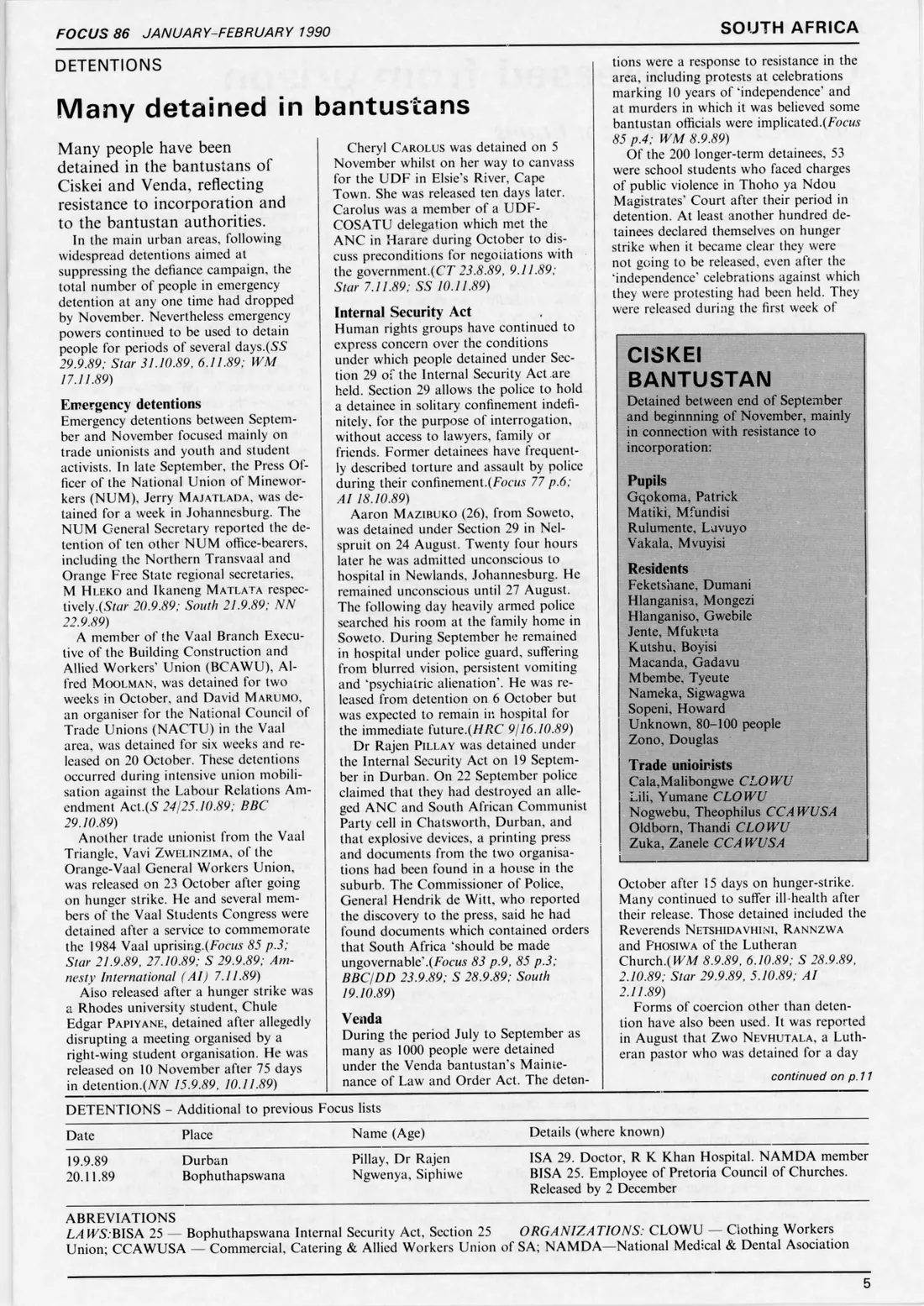
Many detained in bantustans
Many people have been detained in the bantustans of Ciskei and Venda, reflecting resistance to incorporation and to the bantustan authorities.
In the main urban areas, following widespread detentions aimed at suppressing the defiance campaign, the total number of people in emergency detention at any one time had dropped by November. Nevertheless emergency powers continued to be used to detain people for periods of several days.
Emergency detentions
Emergency detentions between September and November focused mainly on trade unionists and youth and student activists. In late September, the Press Officer of the National Union of Mineworkers (NUM), Jerry MAJATLADA, was detained for a week in Johannesburg. The NUM General Secretary reported the detention of ten other NUM office-bearers, including the Northern Transvaal and Orange Free State regional secretaries, M HLEKO and Ikaneng MATLABA respectively.
A member of the Vaal Branch Executive of the Building Construction and Allied Workers' Union (BCAWU), Alfred MOOLMAN, was detained for two weeks in October, and David MARUMO, an organiser for the National Council of Trade Unions (NACTU) in the Vaal area, was detained for six weeks and released on 20 October. These detentions occurred during intensive union mobilisation against the Labour Relations Amendment Act.
Another trade unionist from the Vaal Triangle, Vavi ZWELINZIMA, of the Orange-Vaal General Workers Union, was released on 23 October after going on hunger strike. He and several members of the Vaal Students Congress were detained after a service to commemorate the 1984 Vaal uprising.
Also released after a hunger strike was a Rhodes university student, Chule Edgar PAPIYANE, detained after allegedly disrupting a meeting organised by a right-wing student organisation. He was released on 10 November after 75 days in detention.
Cheryl CAROLUS was detained on 5 November whilst on her way to canvass for the UDF in Elsie's River, Cape Town. She was released ten days later. Carolus was a member of a UDF-COSATU delegation which met the ANC in Harare during October to discuss preconditions for negotiations with the government.
Internal Security Act
Human rights groups have continued to express concern over the conditions under which people detained under Section 29 of the Internal Security Act are held. Section 29 allows the police to hold a detainee in solitary confinement indefinitely, for the purpose of interrogation, without access to lawyers, family or friends. Former detainees have frequently described torture and assault by police during their confinement.
Aaron MAZIBUKO (26), from Soweto, was detained under Section 29 in Nelspruit on 24 August. Twenty four hours later he was admitted unconscious to hospital in Newlands, Johannesburg. He remained unconscious until 27 August. The following day heavily armed police searched his room at the family home in Soweto. During September he remained in hospital under police guard, suffering from blurred vision, persistent vomiting and 'psychiatric alienation'. He was released from detention on 6 October but was expected to remain in hospital for the immediate future.
Dr Rajen PILLAY was detained under the Internal Security Act on 19 September in Durban. On 22 September police claimed that they had destroyed an alleged ANC and South African Communist Party cell in Chatsworth, Durban, and that explosive devices, a printing press and documents from the two organisations had been found in a house in the suburb. The Commissioner of Police, General Hendrik de Witt, who reported the discovery to the press, said he had found documents which contained orders that South Africa 'should be made ungovernable'.
During the period July to September as many as 1000 people were detained under the Venda bantustan's Maintenance of Law and Order Act. The detentions were a response to resistance in the area, including protests at celebrations marking 10 years of 'independence' and at murders in which it was believed some bantustan officials were implicated.
Of the 200 longer-term detainees, 53 were school students who faced charges of public violence in Thoho ya Ndou Magistrates' Court after their period in detention. At least another hundred detainees declared themselves on hunger strike when it became clear they were not going to be released, even after the 'independence' celebrations against which they were protesting had been held. They were released during the first week of October after 15 days on hunger-strike. Many continued to suffer ill-health after their release. Those detained included the Reverends NETSHIDAVHINI, RANNZWA and PHOSIWA of the Lutheran Church.
Forms of coercion other than detention have also been used. It was reported in August that Zwo NEVHUTALA, a Lutheran pastor who was detained for a day and interrogated, was receiving death threats from an organisation named Tshitangu Tsha Philamisevhe. The organisation was established to combat resistance in the bantustan, and teachers and students were being pressurised by the authorities into joining it.
CISKEI BANTUSTAN
Detained between end of September and beginning of November, mainly in connection with resistance to incorporation:
Pupils: Gqokoma, Patrick; Matiki, Mfundisi; Rulumente, Luvuyo; Vakala, Mvuyisi
Residents: Feketsiane, Dumani; Hlanganisa, Mongezi; Hlanganiso, Gwebile; Jente, Mfukuta; Kutshu, Boyisi; Macanda, Gadavu; Mbembe, Tyeute; Nameka, Sigwagwa; Sopeni, Howard; Unknown, 80-100 people; Zono, Douglas
Trade unionists: Cala, Malibongwe CLOWU; Lili, Yumane CLOWU; Nogwebu, Theophilus CCAWUSA; Oldborn, Thandi CLOWU; Zuka, Zanele CCAWUSA
DETENTIONS - Additional to previous Focus lists
19.9.89 Durban: Pillay, Dr Rajen (ISA 29. Doctor, R K Khan Hospital. NAMDA member) 20.11.89 Bophuthapswana: Ngwenya, Siphiwe (BISA 25. Employee of Pretoria Council of Churches. Released by 2 December)