The SWAPO president, Sam Nujoma, opened the first session of the Namibian Constituent Assembly on 21 November, following SWAPO's election victory earlier in the month. Despite incidents of violence, South Africa's failure to meet the requirements of the UN plan and its last-minute attempts to undermine the process, the elections were certified as free and fair by the UN. SWAPO was confident of leading the country to early independence.
SWAPO declared itself pleased with the election results, despite the inherent bias against it as a result of South African activities. President Nujoma stated that there were 'no losers' as the Namibian people had delivered a decisive vote against the South African occupation of their country.
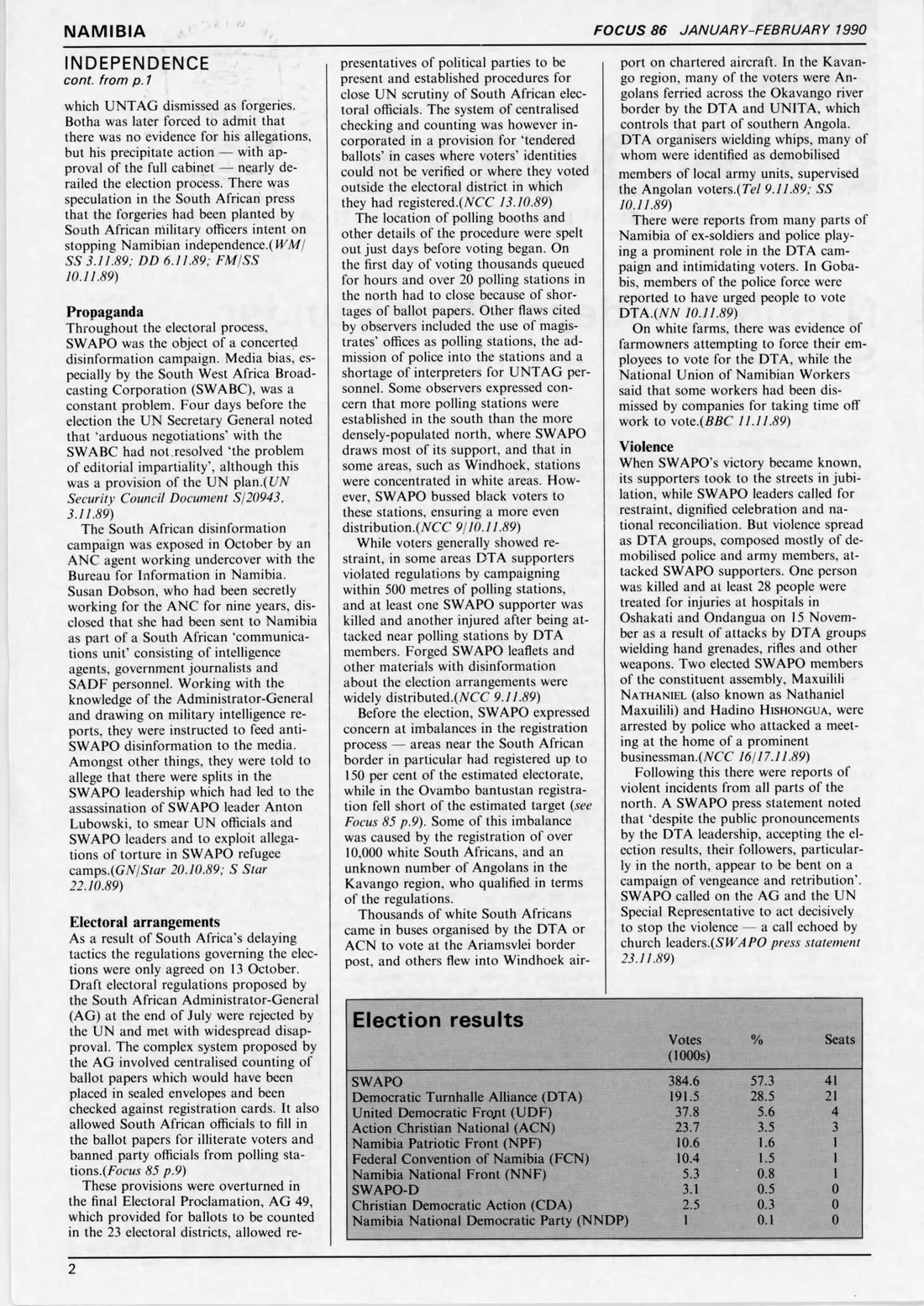
The determination of the Namibian people to decide their own future was underlined by the disciplined conduct of voters and the 96 per cent turnout of the registered electorate on the five polling days between 7 and 11 November. Overall, SWAPO gained 384,567 of the 670,830 valid votes cast (57 per cent). The Democratic Turnhalle Alliance (DTA), an alliance of parties which mainly arose from South African bantustan structures, took 28 per cent, while none of the other parties or alliances gained more than six per cent.
The two alliances based around separate wings of the South-West Africa National Union (SWANU) — the Namibia National Front and the Namibia Patriotic Front — fared badly, each picking up just over 1.5 per cent of the vote, as did the right-wing Federal Convention of Namibia. The United Democratic Front (UDF), based on the Damaraland bantustan administration, polled well in Damaraland and took five per cent of the overall vote, while the exclusively white Action Christian National, an election front for the National Party of South-West Africa, gained three per cent.
The parties were allocated seats in the 72-member Constituent Assembly on the basis of their share of the vote — giving SWAPO 41 seats, the DTA 21 and the other parties 10 between them. The Assembly will draw up a constitution and set a date for independence. As a two-thirds majority is required to adopt the constitution, SWAPO needs support from other parties, but its leaders were confident of achieving this.
SWAPO gained 93 per cent of the vote in the former Ovambo bantustan, the main theatre of war and home to over a third of the electorate. But over 40 per cent of the SWAPO vote was drawn from other areas of the country. SWAPO support was especially strong in the Kavango area, Windhoek and the coastal towns, and was weakest in areas dominated by white-owned farms, where the movement had had difficulty getting access to farmworkers.
Pre-election crisis
The powers of the Constituent Assembly were established only a few days before the election as a result of South Africa's refusal to meet UN demands. Other requirements of the plan — notably the disbanding of military and para-military forces — also remained unfulfilled or were implemented months behind schedule.
The Commonwealth Observer Group noted in a report published on 10 October that 'the obstructive tactics, and belated, grudging concessions of [South Africa's] Administrator-General have placed innumerable and needless obstacles in the path of the [UN] Special Representative in particular, and the political process in general'.
On 18 October the African Group at the UN tabled a detailed statement following a comprehensive report drawn up by the UN Secretary General. They noted that: * Electoral arrangements were left too late for proper implementation * South African police and military units remained active. * Some restrictive and discriminatory laws and proclamations had not been repealed. * Voter registration had been imbalanced and many white South Africans had registered.
On 31 October the UN Security Council addressed these concerns in Resolution 643, which demanded 'immediate, full and strict compliance' with the UN plan 'by all parties concerned, in particular South Africa'. The Security Council also demanded the immediate disbanding of South African military and para-military forces in Namibia.
The day after this resolution was adopted, the South African Minister of Foreign Affairs, Pik Botha, made a dramatic announcement that he had placed military forces in Namibia on full alert and might abandon the independence process altogether because SWAPO forces were preparing to invade Namibia from Angola. He cited alleged transcripts of UNTAG military communications, which UNTAG dismissed as forgeries. Botha was later forced to admit that there was no evidence for his allegations, but his precipitate action — with approval of the full cabinet — nearly de-railed the election process. There was speculation in the South African press that the forgeries had been planted by South African military officers intent on stopping Namibian independence.
Propaganda
Throughout the electoral process, SWAPO was the object of a concerted disinformation campaign. Media bias, especially by the South West Africa Broadcasting Corporation (SWABC), was a constant problem. Four days before the election the UN Secretary General noted that 'arduous negotiations' with the SWABC had not resolved 'the problem of editorial impartiality', although this was a provision of the UN plan.
The South African disinformation campaign was exposed in October by an ANC agent working undercover with the Bureau for Information in Namibia. Susan Dobson, who had been secretly working for the ANC for nine years, disclosed that she had been sent to Namibia as part of a South African 'communications unit' consisting of intelligence agents, government journalists and SADF personnel. Working with the knowledge of the Administrator-General and drawing on military intelligence reports, they were instructed to feed anti-SWAPO disinformation to the media. Amongst other things, they were told to allege that there were splits in the SWAPO leadership which had led to the assassination of SWAPO leader Anton Lubowski, to smear UN officials and SWAPO leaders and to exploit allegations of torture in SWAPO refugee camps.
Electoral arrangements
As a result of South Africa's delaying tactics the regulations governing the elections were only agreed on 13 October. Draft electoral regulations proposed by the South African Administrator-General (AG) at the end of July were rejected by the UN and met with widespread disappointment. The complex system proposed by the AG involved centralised counting of ballot papers which would have been placed in sealed envelopes and been checked against registration cards. It also allowed South African officials to fill in the ballot papers for illiterate voters and banned party officials from polling stations.
These provisions were overturned in the final Electoral Proclamation, AG 49, which provided for ballots to be counted in the 23 electoral districts, allowed representatives of political parties to be present and established procedures for close UN scrutiny of South African electoral officials. The system of centralised checking and counting was however incorporated in a provision for 'tendered ballots' in cases where voters' identities could not be verified or where they voted outside the electoral district in which they had registered.
The location of polling booths and other details of the procedure were spelt out just days before voting began. On the first day of voting thousands queued for hours and over 20 polling stations in the north had to close because of shortages of ballot papers. Other flaws cited by observers included the use of magistrates' offices as polling stations, the admission of police into the stations and a shortage of interpreters for UNTAG personnel. Some observers expressed concern that more polling stations were established in the south than the more densely-populated north, where SWAPO draws most of its support, and that in some areas, such as Windhoek, stations were concentrated in white areas. However, SWAPO bussed black voters to these stations, ensuring a more even distribution.
While voters generally showed restraint, in some areas DTA supporters violated regulations by campaigning within 500 metres of polling stations, and at least one SWAPO supporter was killed and another injured after being attacked near polling stations by DTA members. Forged SWAPO leaflets and other materials with disinformation about the election arrangements were widely distributed.
Before the election, SWAPO expressed concern at imbalances in the registration process — areas near the South African border in particular had registered up to 150 per cent of the estimated electorate, while in the Ovambo bantustan registration fell short of the estimated target. Some of this imbalance was caused by the registration of over 10,000 white South Africans, and an unknown number of Angolans in the Kavango region, who qualified in terms of the regulations.
Thousands of white South Africans came in buses organised by the DTA or ACN to vote at the Ariamsvlei border post, and others flew into Windhoek airport on chartered aircraft. In the Kavango region, many of the voters were Angolans ferried across the Okavango river border by the DTA and UNITA, which controls that part of southern Angola. DTA organisers wielding whips, many of whom were identified as demobilised members of local army units, supervised the Angolan voters.
There were reports from many parts of Namibia of ex-soldiers and police playing a prominent role in the DTA campaign and intimidating voters. In Gobabis, members of the police force were reported to have urged people to vote DTA.
On white farms, there was evidence of farmowners attempting to force their employees to vote for the DTA, while the National Union of Namibian Workers said that some workers had been dismissed by companies for taking time off work to vote.
Violence
When SWAPO's victory became known, its supporters took to the streets in jubilation, while SWAPO leaders called for restraint, dignified celebration and national reconciliation. But violence spread as DTA groups, composed mostly of demobilised police and army members, attacked SWAPO supporters. One person was killed and at least 28 people were treated for injuries at hospitals in Oshakati and Ondangua on 15 November as a result of attacks by DTA groups wielding hand grenades, rifles and other weapons. Two elected SWAPO members of the constituent assembly, Maxuili NATHANIEL (also known as Nathaniel Maxuili) and Hadino HISHONGUA, were arrested by police who attacked a meeting at the home of a prominent businessman.
Following this there were reports of violent incidents from all parts of the north. A SWAPO press statement noted that 'despite the public pronouncements by the DTA leadership, accepting the election results, their followers, particularly in the north, appear to be bent on a campaign of vengeance and retribution'. SWAPO called on the AG and the UN Special Representative to act decisively to stop the violence — a call echoed by church leaders.