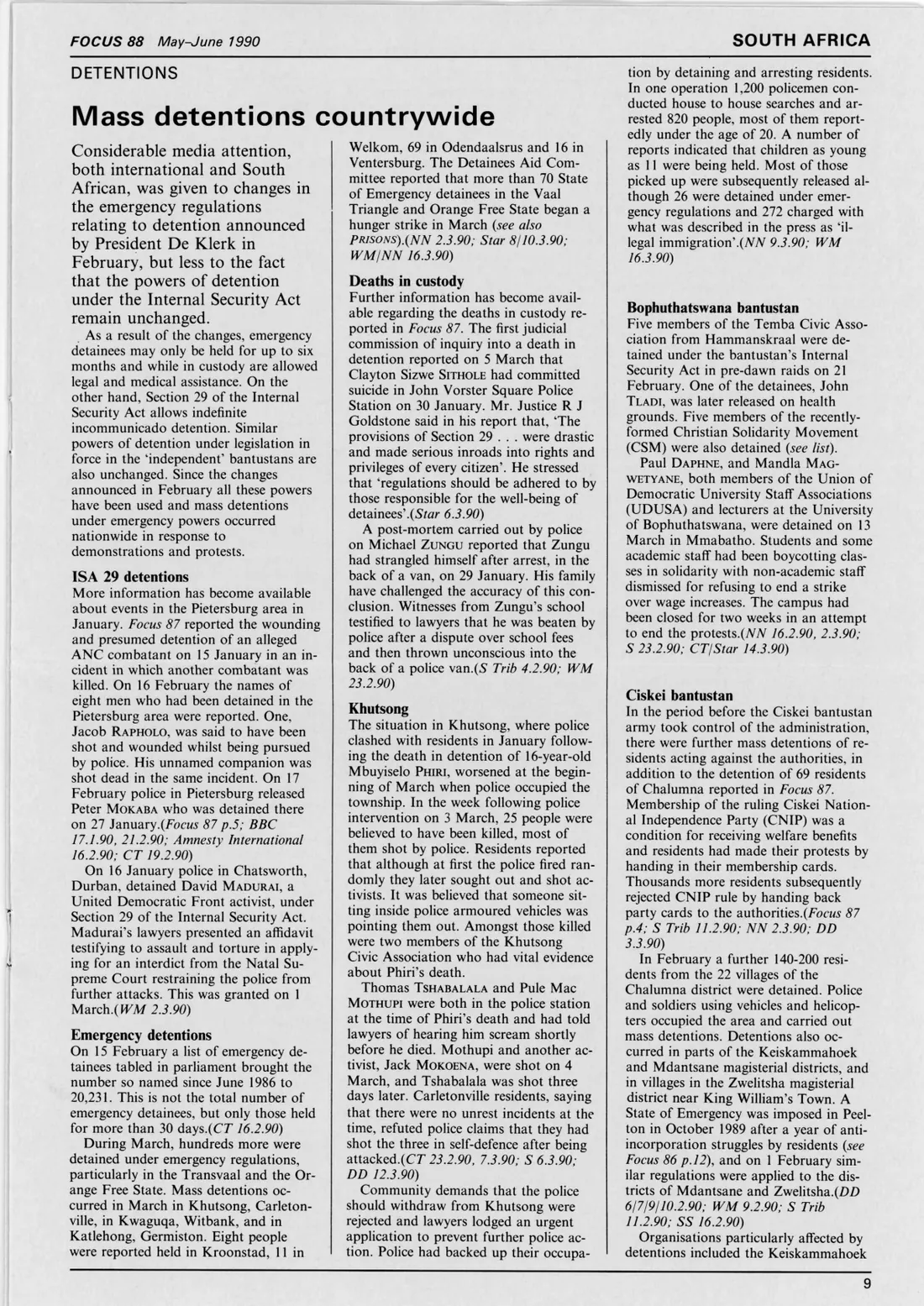
Considerable media attention, both international and South African, was given to changes in the emergency regulations relating to detention announced by President De Klerk in February, but less to the fact that the powers of detention under the Internal Security Act remain unchanged.
As a result of the changes, emergency detainees may only be held for up to six months and while in custody are allowed legal and medical assistance. On the other hand, Section 29 of the Internal Security Act allows indefinite uncommunicated detention. Similar powers of detention under legislation in force in the 'independent' bantustans are also unchanged. Since the changes announced in February all these powers have been used and mass detentions under emergency powers occurred nationwide in response to demonstrations and protests.
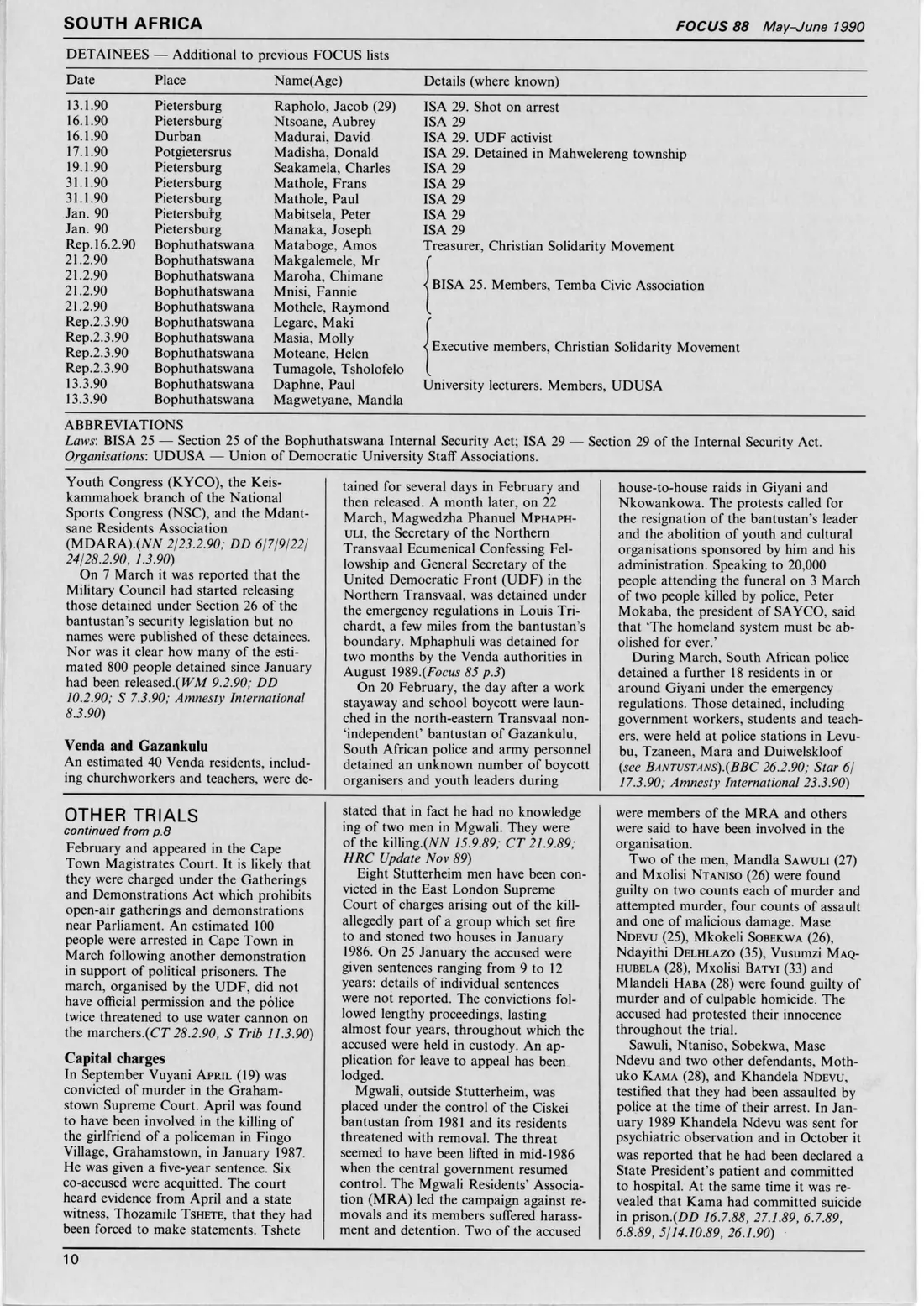
More information has become available about events in the Pietersburg area in January. Focus 87 reported the wounding and presumed detention of an alleged ANC combatant on 15 January in an incident in which another combatant was killed. On 16 February the names of eight men who had been detained in the Pietersburg area were reported. One, Jacob RAPHOLO, was said to have been shot and wounded whilst being pursued by police. His unnamed companion was shot dead in the same incident. On 17 February police in Pietersburg released Peter MOKABA who was detained there on 27 January.
On 16 January police in Chatsworth, Durban, detained David MADURAI, a United Democratic Front activist, under Section 29 of the Internal Security Act. Madurai's lawyers presented an affidavit testifying to assault and torture in applying for an interdict from the Natal Supreme Court restraining the police from further attacks. This was granted on 1 March.
On 15 February a list of emergency detainees tabled in parliament brought the number so named since June 1986 to 20,231. This is not the total number of emergency detainees, but only those held for more than 30 days.
During March, hundreds more were detained under emergency regulations, particularly in the Transvaal and the Orange Free State. Mass detentions occurred in March in Khutsong, Carletonville, in Kwaguqa, Witbank, and in Katlehong, Germiston. Eight people were reported held in Kroonstad, 11 in Welkom, 69 in Odendaalsrus and 16 in Ventersburg. The Detainees Aid Committee reported that more than 70 State of Emergency detainees in the Vaal Triangle and Orange Free State began a hunger strike in March.
Further information has become available regarding the deaths in custody reported in Focus 87. The first judicial commission of inquiry into a death in detention reported on 5 March that Clayton Sizwe SITHOLE had committed suicide in John Vorster Square Police Station on 30 January. Mr. Justice R J Goldstone said in his report that, 'The provisions of Section 29 ... were drastic and made serious inroads into rights and privileges of every citizen'. He stressed that 'regulations should be adhered to by those responsible for the well-being of detainees'.
A post-mortem carried out by police on Michael ZUNGU reported that Zungu had strangled himself after arrest, in the back of a van, on 29 January. His family have challenged the accuracy of this conclusion. Witnesses from Zungu's school testified to lawyers that he was beaten by police after a dispute over school fees and then thrown unconscious into the back of a police van.
The situation in Khutsong, where police clashed with residents in January following the death in detention of 16-year-old Mbuyiselo PHIRI, worsened at the beginning of March when police occupied the township. In the week following police intervention on 3 March, 25 people were believed to have been killed, most of them shot by police. Residents reported that although at first the police fired randomly they later sought out and shot activists. It was believed that someone sitting inside police armoured vehicles was pointing them out. Amongst those killed were two members of the Khutsong Civic Association who had vital evidence about Phiri's death.
Thomas TSHABALALA and Pule Mac MOTHUPI were both in the police station at the time of Phiri's death and had told lawyers of hearing him scream shortly before he died. Mothupi and another activist, Jack MOKOENA, were shot on 4 March, and Tshabalala was shot three days later. Carletonville residents, saying that there were no unrest incidents at the time, refuted police claims that they had shot the three in self-defence after being attacked.
Community demands that the police should withdraw from Khutsong were rejected and lawyers lodged an urgent application to prevent further police action. Police had backed up their occupation by detaining and arresting residents. In one operation 1,200 policemen conducted house to house searches and arrested 820 people, most of them reportedly under the age of 20. A number of reports indicated that children as young as 11 were being held. Most of those picked up were subsequently released although 26 were detained under emergency regulations and 272 charged with what was described in the press as 'illegal immigration'.
Five members of the Temba Civic Association from Hammanskraal were detained under the bantustan's Internal Security Act in pre-dawn raids on 21 February. One of the detainees, John TLADI, was later released on health grounds. Five members of the recently-formed Christian Solidarity Movement (CSM) were also detained.
Paul DAPHNE, and Mandla MAGWETYANE, both members of the Union of Democratic University Staff Associations (UDUSA) and lecturers at the University of Bophuthatswana, were detained on 13 March in Mmabatho. Students and some academic staff had been boycotting classes in solidarity with non-academic staff dismissed for refusing to end a strike over wage increases. The campus had been closed for two weeks in an attempt to end the protests.
In the period before the Ciskei bantustan army took control of the administration, there were further mass detentions of residents acting against the authorities, in addition to the detention of 69 residents of Chalumna reported in Focus 87. Membership of the ruling Ciskei National Independence Party (CNIP) was a condition for receiving welfare benefits and residents had made their protests by handing in their membership cards. Thousands more residents subsequently rejected CNIP rule by handing back party cards to the authorities.
In February a further 140-200 residents from the 22 villages of the Chalumna district were detained. Police and soldiers using vehicles and helicopters occupied the area and carried out mass detentions. Detentions also occurred in parts of the Keiskammahoek and Mdantsane magisterial districts, and in villages in the Zwelitsha magisterial district near King William's Town. A State of Emergency was imposed in Peleton in October 1989 after a year of anti-incorporation struggles by residents, and on 1 February similar regulations were applied to the districts of Mdantsane and Zwelitsha.
Organisations particularly affected by detentions included the Keiskammahoek Youth Congress (KYCO), the Keiskammahoek branch of the National Sports Congress (NSC), and the Mdantsane Residents Association (MDARA).
On 7 March it was reported that the Military Council had started releasing those detained under Section 26 of the bantustan's security legislation but no names were published of these detainees. Nor was it clear how many of the estimated 800 people detained since January had been released.
An estimated 40 Venda residents, including churchworkers and teachers, were detained for several days in February and then released. A month later, on 22 March, Magwedzha Phanuel MPHAPHULI, the Secretary of the Northern Transvaal Ecumenical Confessing Fellowship and General Secretary of the United Democratic Front (UDF) in the Northern Transvaal, was detained under the emergency regulations in Louis Trichardt, a few miles from the bantustan's boundary. Mphaphuli was detained for two months by the Venda authorities in August 1989.
On 20 February, the day after a work stayaway and school boycott were launched in the north-eastern Transvaal non-independent bantustan of Gazankulu, South African police and army personnel detained an unknown number of boycott organisers and youth leaders during house-to-house raids in Giyani and Nkowankowa. The protests called for the resignation of the bantustan's leader and the abolition of youth and cultural organisations sponsored by him and his administration. Speaking to 20,000 people attending the funeral on 3 March of two people killed by police, Peter Mokaba, the president of SAYCO, said that 'The homeland system must be abolished for ever.'
During March, South African police detained a further 18 residents in or around Giyani under the emergency regulations. Those detained, including government workers, students and teachers, were held at police stations in Levubu, Tzaneen, Mara and Duiwelskloof.