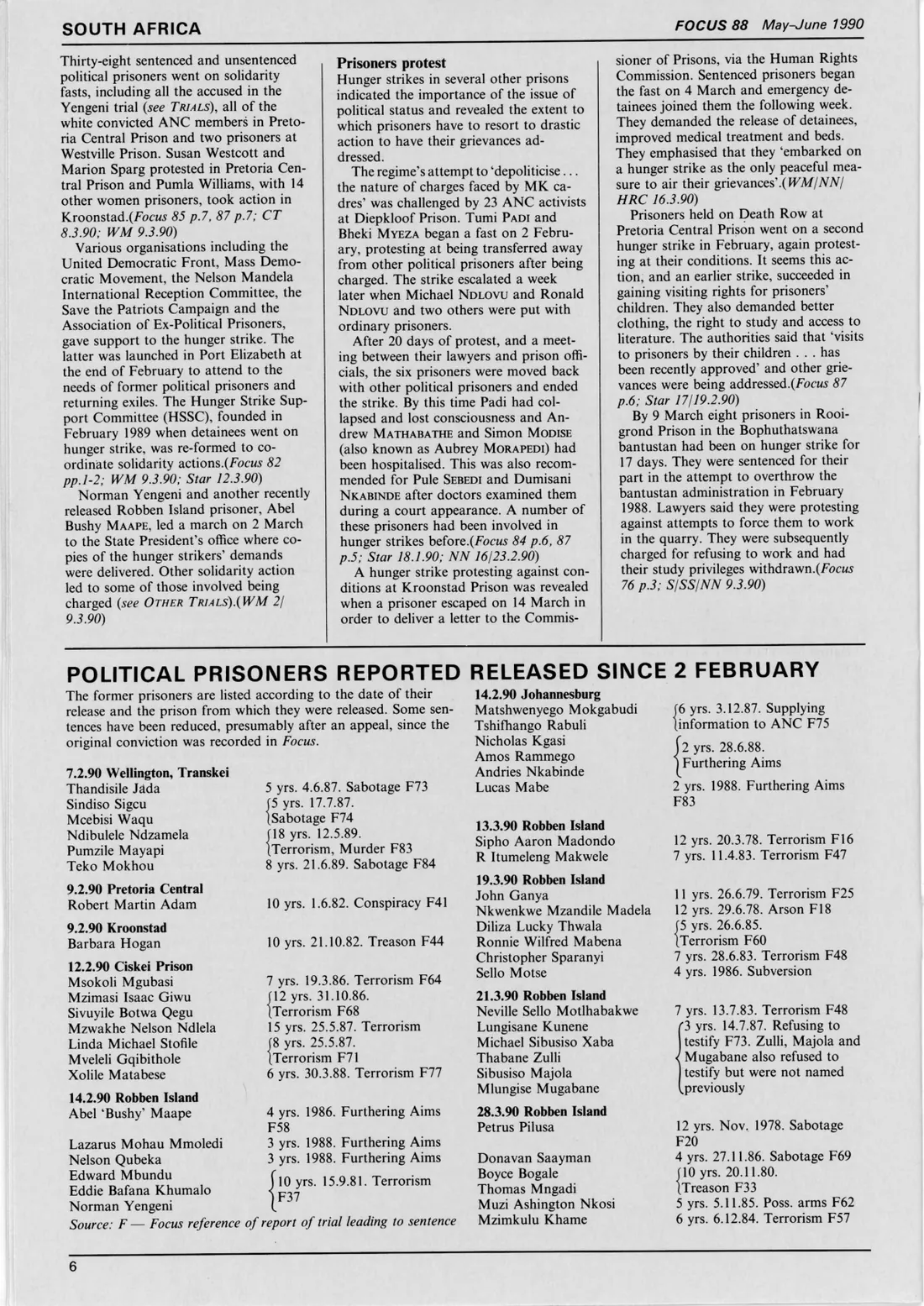
Thirty-eight sentenced and unsentenced political prisoners went on solidarity fasts, including all the accused in the Yengeni trial, all of the white convicted ANC members in Pretoria Central Prison and two prisoners at Westville Prison. Susan Westcott and Marion Sparg protested in Pretoria Central Prison and Pumla Williams, with 14 other women prisoners, took action in Kroonstad.
Various organisations including the United Democratic Front, Mass Democratic Movement, the Nelson Mandela International Reception Committee, the Save the Patriots Campaign and the Association of Ex-Political Prisoners, gave support to the hunger strike. The latter was launched in Port Elizabeth at the end of February to attend to the needs of former political prisoners and returning exiles. The Hunger Strike Support Committee (HSSC), founded in February 1989 when detainees went on hunger strike, was re-formed to co-ordinate solidarity actions.
Norman Yengeni and another recently released Robben Island prisoner, Abel Bushy MAAPE, led a march on 2 March to the State President's office where copies of the hunger strikers' demands were delivered. Other solidarity action led to some of those involved being charged.
Hunger strikes in several other prisons indicated the importance of the issue of political status and revealed the extent to which prisoners have to resort to drastic action to have their grievances addressed.
The regime's attempt to 'depoliticise... the nature of charges faced by MK cadres' was challenged by 23 ANC activists at Dieplokoof Prison. Tumi PADI and Bheki MYEZA began a fast on 2 February, protesting at being transferred away from other political prisoners after being charged. The strike escalated a week later when Michael NDLOVU and Ronald NDLOVU and two others were put with ordinary prisoners.
After 20 days of protest, and a meeting between their lawyers and prison officials, the six prisoners were moved back with other political prisoners and ended the strike. By this time Padi had collapsed and lost consciousness and Andrew MATHABATHE and Simon MODISE (also known as Aubrey MORAPEDI) had been hospitalised. This was also recommended for Pule SEBEDI and Dumisani NKABINDE after doctors examined them during a court appearance. A number of these prisoners had been involved in hunger strikes before.
A hunger strike protesting against conditions at Kroonstad Prison was revealed when a prisoner escaped on 14 March in order to deliver a letter to the Commissioner of Prisons, via the Human Rights Commission. Sentenced prisoners began the fast on 4 March and emergency detainees joined them the following week. They demanded the release of detainees, improved medical treatment and beds. They emphasised that they 'embarked on a hunger strike as the only peaceful measure to air their grievances'.
Prisoners held on Death Row at Pretoria Central Prison went on a second hunger strike in February, again protesting at their conditions. It seems this action, and an earlier strike, succeeded in gaining visiting rights for prisoners' children. They also demanded better clothing, the right to study and access to literature. The authorities said that 'visits to prisoners by their children... has been recently approved' and other grievances were being addressed.
By 9 March eight prisoners in Rooigrond Prison in the Bophuthatswana bantustan had been on hunger strike for 17 days. They were sentenced for their part in the attempt to overthrow the bantustan administration in February 1988. Lawyers said they were protesting against attempts to force them to work in the quarry. They were subsequently charged for refusing to work and had their study privileges withdrawn.