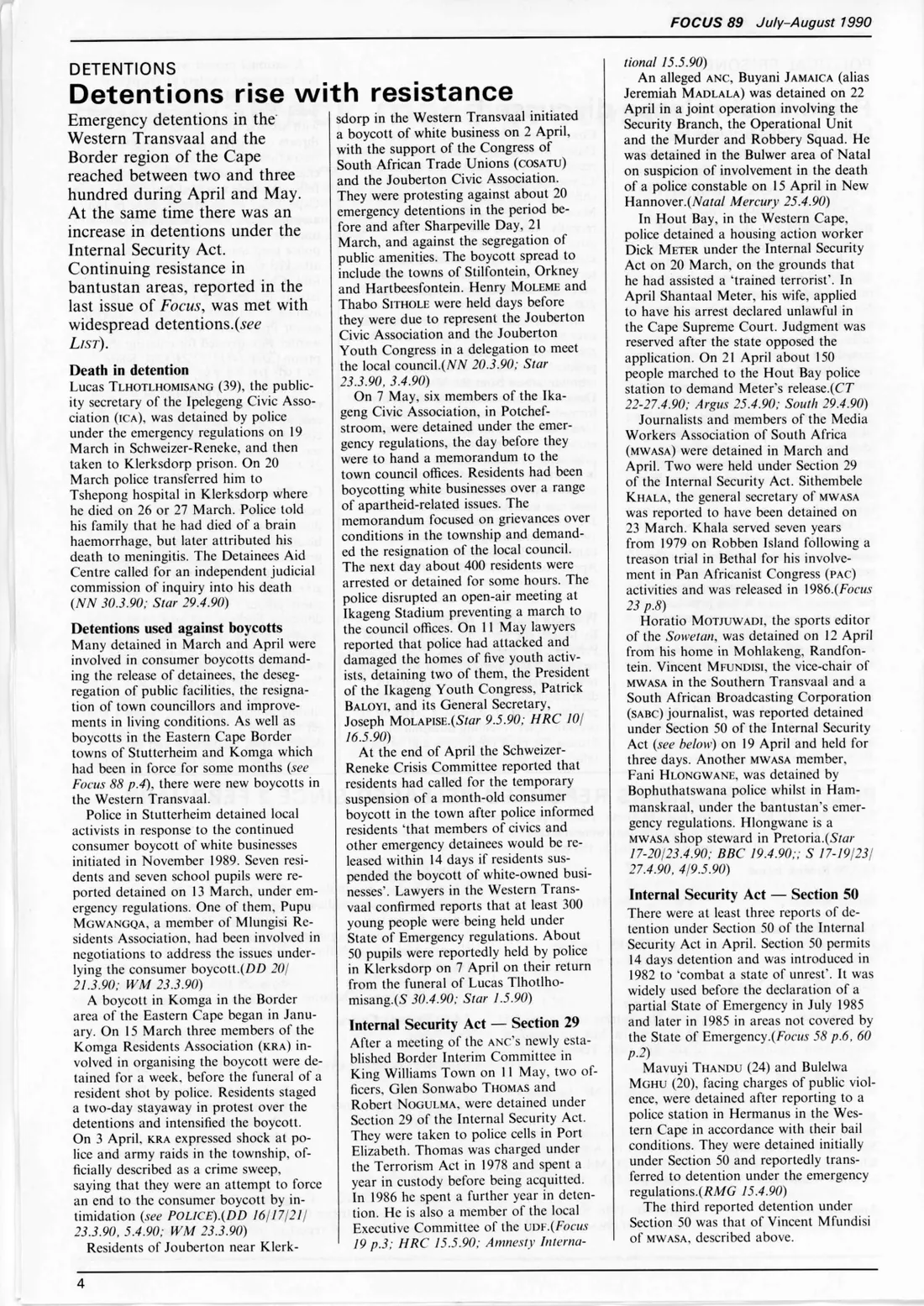
Emergency detentions in the Western Transvaal and the Border region of the Cape reached between two and three hundred during April and May. At the same time there was an increase in detentions under the Internal Security Act. Continuing resistance in bantustan areas, reported in the last issue of Focus, was met with widespread detentions.
Lucas TLHOTHLOMISANG (39), the publicity secretary of the Ipelegeng Civic Association (ICA), was detained by police under the emergency regulations on 19 March in Schweizer-Reneke, and then taken to Klerksdorp prison. On 20 March police transferred him to Tshepong hospital in Klerksdorp where he died on 26 or 27 March. Police told his family that he had died of a brain haemorrhage, but later attributed his death to meningitis. The Detainees Aid Centre called for an independent judicial commission of inquiry into his death.
Many detained in March and April were involved in consumer boycotts demanding the release of detainees, the desegregation of public facilities, the resignation of town councillors and improvements in living conditions. As well as boycotts in the Eastern Cape Border towns of Stutterheim and Komga which had been in force for some months, there were new boycotts in the Western Transvaal.
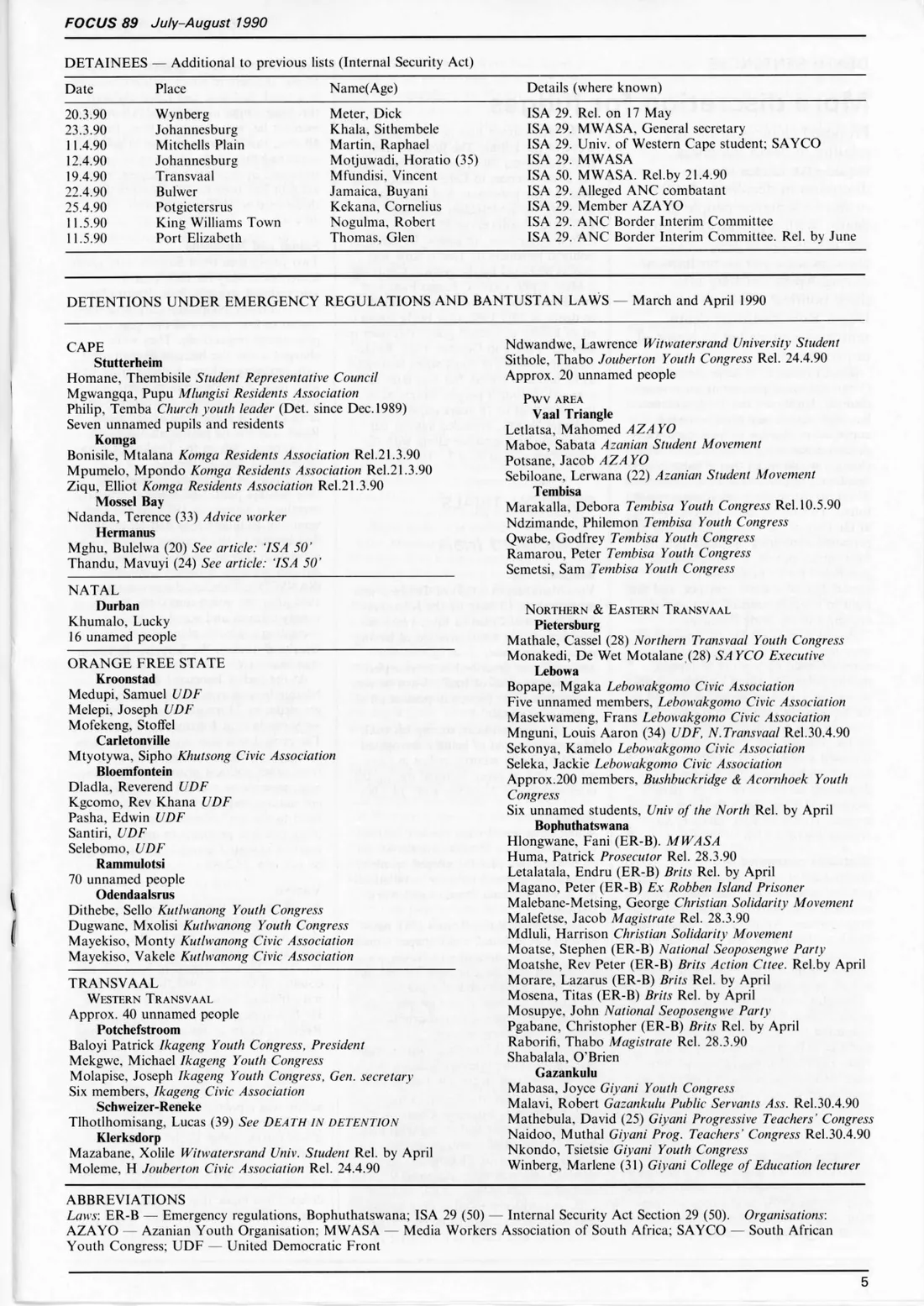
Police in Stutterheim detained local activists in response to the continued consumer boycott of white businesses initiated in November 1989. Seven residents and seven school pupils were reported detained on 13 March, under emergency regulations. One of them, Pupu MGWANGQA, a member of Mlungisi Residents Association, had been involved in negotiations to address the issues underlying the consumer boycott.
A boycott in Komga in the Border area of the Eastern Cape began in January. On 15 March three members of the Komga Residents Association (KRA) involved in organising the boycott were detained for a week, before the funeral of a resident shot by police. Residents staged a two-day stayaway in protest over the detentions and intensified the boycott. On 3 April, KRA expressed shock at police and army raids in the township, officially described as a crime sweep, saying that they were an attempt to force an end to the consumer boycott by intimidation.
Residents of Jouberton near Klerksdorp in the Western Transvaal initiated a boycott of white business on 2 April, with the support of the Congress of South African Trade Unions (COSATU) and the Jouberton Civic Association. They were protesting against about 20 emergency detentions in the period before and after Sharpeville Day, 21 March, and against the segregation of public amenities. The boycott spread to include the towns of Stilfontein, Orkney and Hartbeesfontein. Henry MOLEME and Thabo SITHOLE were held days before they were due to represent the Jouberton Civic Association and the Jouberton Youth Congress in a delegation to meet the local council.
On 7 May, six members of the Ikgeng Civic Association, in Potchefstroom, were detained under the emergency regulations, the day before they were to hand a memorandum to the town council offices. Residents had been boycotting white businesses over a range of apartheid-related issues. The memorandum focused on grievances over conditions in the township and demanded the resignation of the local council. The next day about 400 residents were arrested or detained for some hours. The police disrupted an open-air meeting at Ikgeng Stadium preventing a march to the council offices. On 11 May lawyers reported that police had attacked and damaged the homes of five youth activists, detaining two of them, the President of the Ikgengag Youth Congress, Patrick BALOYI, and its General Secretary, Joseph MOLAPISE.
At the end of April the Schweizer-Reneke Crisis Committee reported that residents had called for the temporary suspension of a month-old consumer boycott in the town after police informed residents 'that members of civics and other emergency detainees would be released within 14 days if residents suspended the boycott of white-owned businesses'. Lawyers in the Western Transvaal confirmed reports that at least 300 young people were being held under State of Emergency regulations. About 50 pupils were reportedly held by police in Klerksdorp on 7 April on their return from the funeral of Lucas Thlotlhomisang.
After a meeting of the ANC's newly established Border Interim Committee in King Williams Town on 11 May, two officers, Glen Sonwabo THOMAS and Robert NOGULMA, were detained under Section 29 of the Internal Security Act. They were taken to police cells in Port Elizabeth. Thomas was charged under the Terrorism Act in 1978 and spent a year in custody before being acquitted. In 1986 he spent a further year in detention. He is also a member of the local Executive Committee of the UDF.
An alleged ANC, Buyani JAMAICA (alias Jeremiah MADLALA) was detained on 22 April in a joint operation involving the Security Branch, the Operational Unit and the Murder and Robbery Squad. He was detained in the Bulwer area of Natal on suspicion of involvement in the death of a police constable on 15 April in New Hannover.
In Hout Bay, in the Western Cape, police detained a housing action worker Dick METER under the Internal Security Act on 20 March, on the grounds that he had assisted a 'trained terrorist'. In April Shantaal Meter, his wife, applied to have his arrest declared unlawful in the Cape Supreme Court. Judgment was reserved after the state opposed the application. On 21 April about 150 people marched to the Hout Bay police station to demand Meter's release.
Journalists and members of the Media Workers Association of South Africa (MWASA) were detained in March and April. Two were held under Section 29 of the Internal Security Act. Sithembele KHALA, the general secretary of MWASA was reported to have been detained on 23 March. Khala served seven years from 1979 on Robben Island following a treason trial in Bethal for his involvement in Pan Africanist Congress (PAC) activities and was released in 1986.
Horatio MOTJUWADI, the sports editor of the Sowetan, was detained on 12 April from his home in Mohlakeng, Randfontein. Vincent MFUNDISI, the vice-chair of MWASA in the Southern Transvaal and a South African Broadcasting Corporation (SABC) journalist, was reported detained under Section 50 of the Internal Security Act on 19 April and held for three days. Another MWASA member, Fani HLONGWANE, was detained by Bophuthatswana police whilst in Hammanskraal, under the bantustan's emergency regulations. Hlongwane is a MWASA shop steward in Pretoria.
There were at least three reports of detention under Section 50 of the Internal Security Act in April. Section 50 permits 14 days detention and was introduced in 1982 to 'combat a state of unrest'. It was widely used before the declaration of a partial State of Emergency in July 1985 and later in 1985 in areas not covered by the State of Emergency.
Mavuyi THANDU (24) and Bulelwa MGHU (20), facing charges of public violence, were detained after reporting to a police station in Hermanus in the Western Cape in accordance with their bail conditions. They were detained initially under Section 50 and reportedly transferred to detention under the emergency regulations.
The third reported detention under Section 50 was that of Vincent Mfundisi of MWASA, described above.