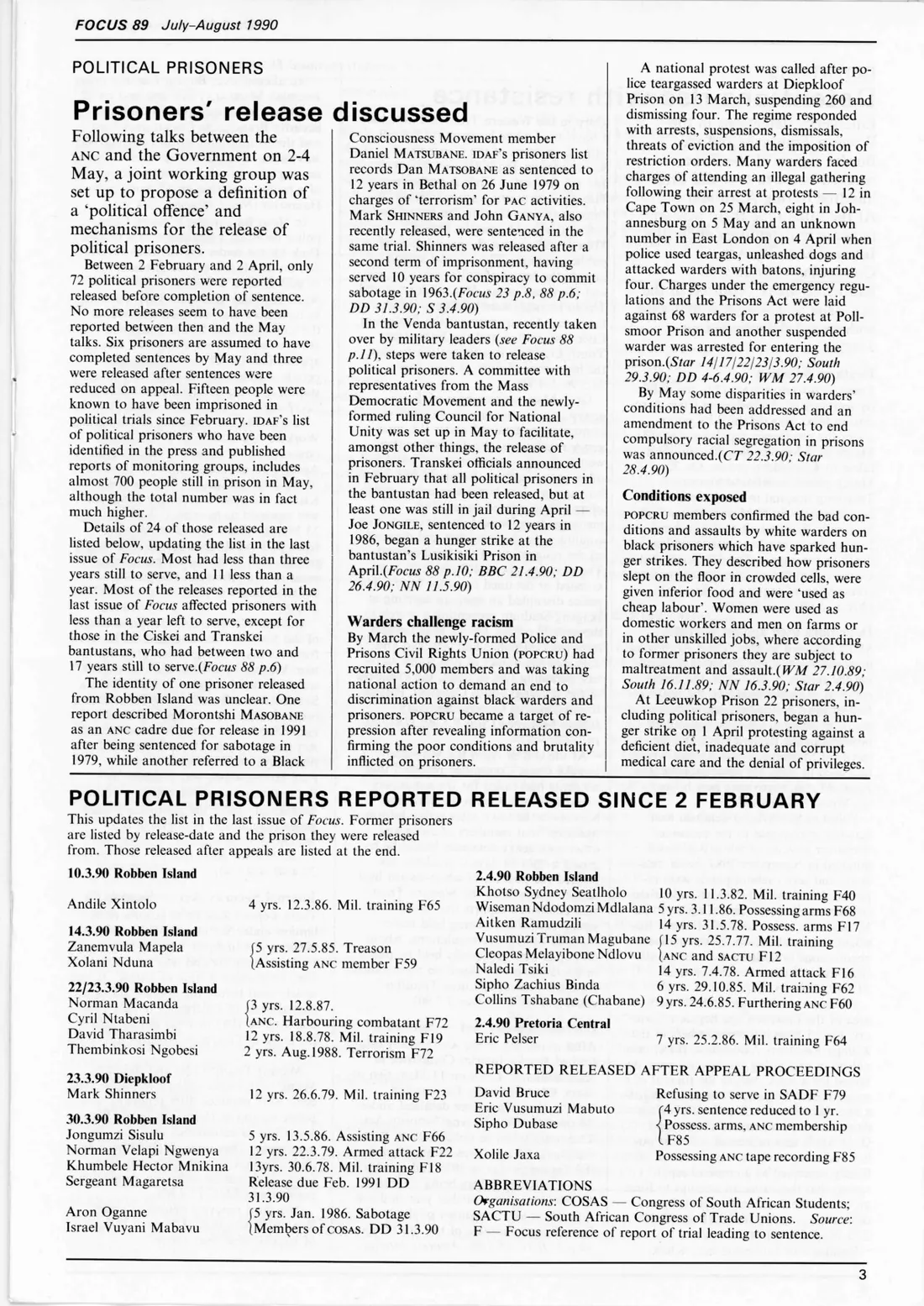
Following talks between the ANC and the Government on 2-4 May, a joint working group was set up to propose a definition of a 'political offence' and mechanisms for the release of political prisoners.
Between 2 February and 2 April, only 72 political prisoners were reported released before completion of sentence. No more releases seem to have been reported between then and the May talks. Six prisoners are assumed to have completed sentences by May and three were released after sentences were reduced on appeal. Fifteen people were known to have been imprisoned in political trials since February. IDAF's list of political prisoners who have been identified in the press and published reports of monitoring groups, includes almost 700 people still in prison in May, although the total number was in fact much higher.
Details of 24 of those released are listed below, updating the list in the last issue of Focus. Most had less than three years still to serve, and 11 less than a year. Most of the releases reported in the last issue of Focus affected prisoners with less than a year left to serve, except for those in the Ciskei and Transkei bantustans, who had between two and 17 years still to serve.
The identity of one prisoner released from Robben Island was unclear. One report described Morontshi MASOBANE as an ANC cadre due for release in 1991 after being sentenced for sabotage in 1979, while another referred to a Black Consciousness Movement member Daniel MATSUBANE. IDAF's prisoners list records Dan MATSOBANE as sentenced to 12 years in Bethal on 26 June 1979 on charges of 'terrorism' for PAC activities. Mark SHINNERS and John GANYA, also recently released, were sentenced in the same trial. Shinners was released after a second term of imprisonment, having served 10 years for conspiracy to commit sabotage in 1963.
In the Venda bantustan, recently taken over by military leaders, steps were taken to release political prisoners. A committee with representatives from the Mass Democratic Movement and the newly-formed ruling Council for National Unity was set up in May to facilitate, amongst other things, the release of prisoners. Transkei officials announced in February that all political prisoners in the bantustan had been released, but at least one was still in jail during April — Joe JONGILE, sentenced to 12 years in 1986, began a hunger strike at the bantustan's Lusikisiki Prison in April.
By March the newly-formed Police and Prisons Civil Rights Union (POPCRU) had recruited 5,000 members and was taking national action to demand an end to discrimination against black warders and prisoners. POPCRU became a target of repression after revealing information confirming the poor conditions and brutality inflicted on prisoners.
A national protest was called after police teargassed warders at Diepkloof Prison on 13 March, suspending 260 and dismissing four. The regime responded with arrests, suspensions, dismissals, threats of eviction and the imposition of restriction orders. Many warders faced charges of attending an illegal gathering following their arrest at protests — 12 in Cape Town on 25 March, eight in Johannesburg on 5 May and an unknown number in East London on 4 April when police used teargas, unleashed dogs and attacked warders with batons, injuring four. Charges under the emergency regulations and the Prisons Act were laid against 68 warders for a protest at Pollsmoor Prison and another suspended warder was arrested for entering the prison.
By May some disparities in warders' conditions had been addressed and an amendment to the Prisons Act to end compulsory racial segregation in prisons was announced.
POPCRU members confirmed the bad conditions and assaults by white warders on black prisoners which have sparked hunger strikes. They described how prisoners slept on the floor in crowded cells, were given inferior food and were 'used as cheap labour'. Women were used as domestic workers and men on farms or in other unskilled jobs, where according to former prisoners they are subject to maltreatment and assault.
At Leeuwkop Prison 22 prisoners, including political prisoners, began a hunger strike on 1 April protesting against a deficient diet, inadequate and corrupt medical care and the denial of privileges.