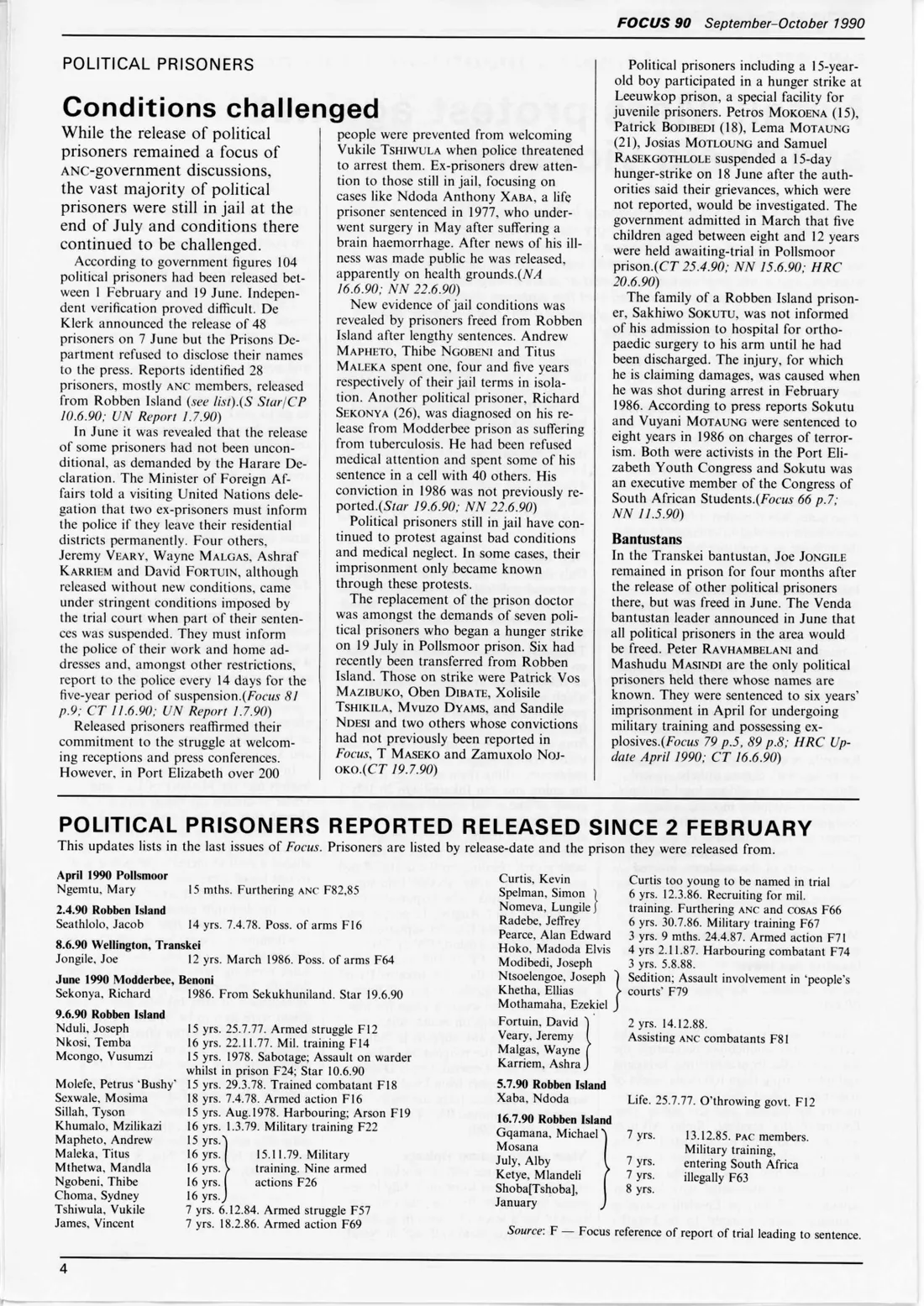
While the release of political prisoners remained a focus of ANC-government discussions, the vast majority of political prisoners were still in jail at the end of July and conditions there continued to be challenged.
According to government figures 104 political prisoners had been released between 1 February and 19 June. Independent verification proved difficult. De Klerk announced the release of 48 prisoners on 7 June but the Prisons Department refused to disclose their names to the press. Reports identified 28 prisoners, mostly ANC members, released from Robben Island.
In June it was revealed that the release of some prisoners had not been unconditional, as demanded by the Harare Declaration. The Minister of Foreign Affairs told a visiting United Nations delegation that two ex-prisoners must inform the police if they leave their residential districts permanently. Four others, Jeremy VEARY, Wayne MALGAS, Ashraf KARRIEM and David FORTUIN, although released without new conditions, came under stringent conditions imposed by the trial court when part of their sentences was suspended. They must inform the police of their work and home addresses and, amongst other restrictions, report to the police every 14 days for the five-year period of suspension.
Released prisoners reaffirmed their commitment to the struggle at welcoming receptions and press conferences. However, in Port Elizabeth over 200 people were prevented from welcoming Vukile TSHIWULA when police threatened to arrest them. Ex-prisoners drew attention to those still in jail, focusing on cases like Ndoda Anthony XABA, a life prisoner sentenced in 1977, who underwent surgery in May after suffering a brain haemorrhage. After news of his illness was made public he was released, apparently on health grounds.
New evidence of jail conditions was revealed by prisoners freed from Robben Island after lengthy sentences. Andrew MAPHETO, Thibe NGOBENI and Titus MALEKA spent one, four and five years respectively of their jail terms in isolation. Another political prisoner, Richard SEKONYA (26), was diagnosed on his release from Modderbee prison as suffering from tuberculosis. He had been refused medical attention and spent some of his sentence in a cell with 40 others. His conviction in 1986 was not previously reported.
Political prisoners still in jail have continued to protest against bad conditions and medical neglect. In some cases, their imprisonment only became known through these protests.
The replacement of the prison doctor was amongst the demands of seven political prisoners who began a hunger strike on 19 July in Pollsmoor prison. Six had recently been transferred from Robben Island. Those on strike were Patrick Vos MAZIBUKO, Oben DIBATE, Xolisile TSHIKILA, MvuZO DYAMS, and Sandile NDESI and two others whose convictions had not previously been reported in Focus, T MASEKO and Zamuxolo NOJOKO.
Political prisoners including a 15-year-old boy participated in a hunger strike at Leeuwkop prison, a special facility for juvenile prisoners. Petros MOKOENA (15), Patrick BODIBEDI (18), Lema MOTAUNG (21), Josias MOTLOUNG and Samuel RASEKGOTHLOLE suspended a 15-day hunger-strike on 18 June after the authorities said their grievances, which were not reported, would be investigated. The government admitted in March that five children aged between eight and 12 years were held awaiting-trial in Pollsmoor prison.
The family of a Robben Island prisoner, Sakhiwo SOKUTU, was not informed of his admission to hospital for orthopaedic surgery to his injury until he had been discharged. The injury, for which he is claiming damages, was caused when he was shot during arrest in February 1986. According to press reports Sokutu and Vuyani MOTAUNG were sentenced to eight years in 1986 on charges of terrorism. Both were activists in the Port Elizabeth Youth Congress and Sokutu was an executive member of the Congress of South African Students.
In the Transkei bantustan, Joe JONGILE remained in prison for four months after the release of other political prisoners there, but was freed in June. The Venda bantustan leader announced in June that all political prisoners in the area would be freed. Peter RAVHAMBELANI and Mashudu MASINDI are the only political prisoners held there whose names are known. They were sentenced to six years' imprisonment in April for undergoing military training and possessing explosives.