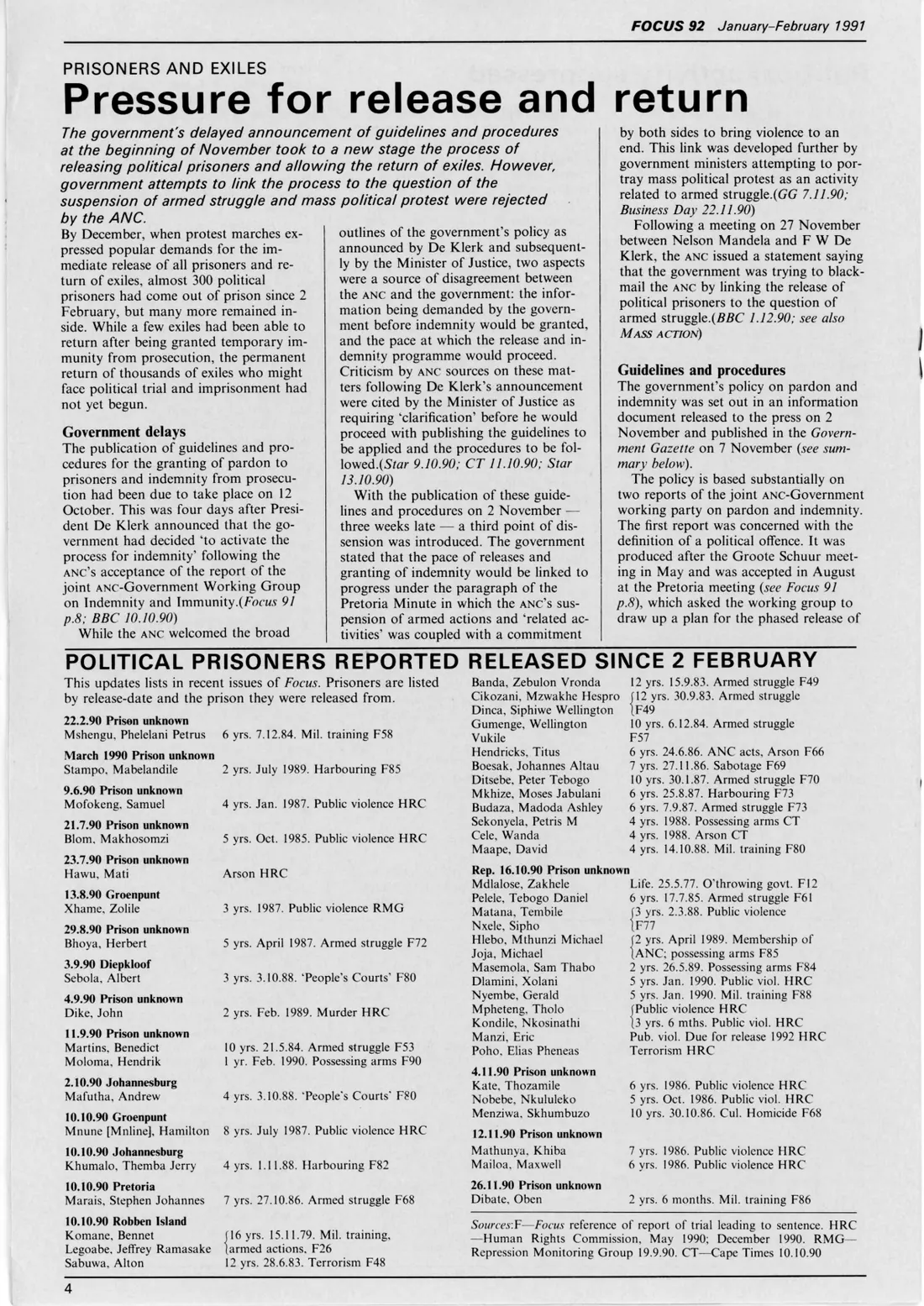
The government's delayed announcement of guidelines and procedures at the beginning of November took to a new stage the process of releasing political prisoners and allowing the return of exiles. However, government attempts to link the process to the question of the suspension of armed struggle and mass political protest were rejected by the ANC.
By December, when protest marches expressed popular demands for the immediate release of all prisoners and return of exiles, almost 300 political prisoners had come out of prison since 2 February, but many more remained inside. While a few exiles had been able to return after being granted temporary immunity from prosecution, the permanent return of thousands of exiles who might face political trial and imprisonment had not yet begun.
The publication of guidelines and procedures for the granting of pardon to prisoners and indemnity from prosecution had been due to take place on 12 October. This was four days after President De Klerk announced that the government had decided 'to activate the process for indemnity' following the ANC's acceptance of the report of the joint ANC-Government Working Group on Indemnity and Immunity.
While the ANC welcomed the broad outlines of the government's policy as announced by De Klerk and subsequently by the Minister of Justice, two aspects were a source of disagreement between the ANC and the government: the information being demanded by the government before indemnity would be granted, and the pace at which the release and indemnity programme would proceed.
Criticism by ANC sources on these matters following De Klerk's announcement were cited by the Minister of Justice as requiring 'clarification' before he would proceed with publishing the guidelines to be applied and the procedures to be followed.
With the publication of these guidelines and procedures on 2 November — three weeks late — a third point of discussion was introduced. The government stated that the pace of releases and granting of indemnity would be linked to progress under the paragraph of the Pretoria Minute in which the ANC's suspension of armed actions and 'related activities' was coupled with a commitment by both sides to bring violence to an end. This link was developed further by government ministers attempting to portray mass political protest as an activity related to armed struggle.
Following a meeting on 27 November between Nelson Mandela and F W De Klerk, the ANC issued a statement saying that the government was trying to blackmail the ANC by linking the release of political prisoners to the question of armed struggle.
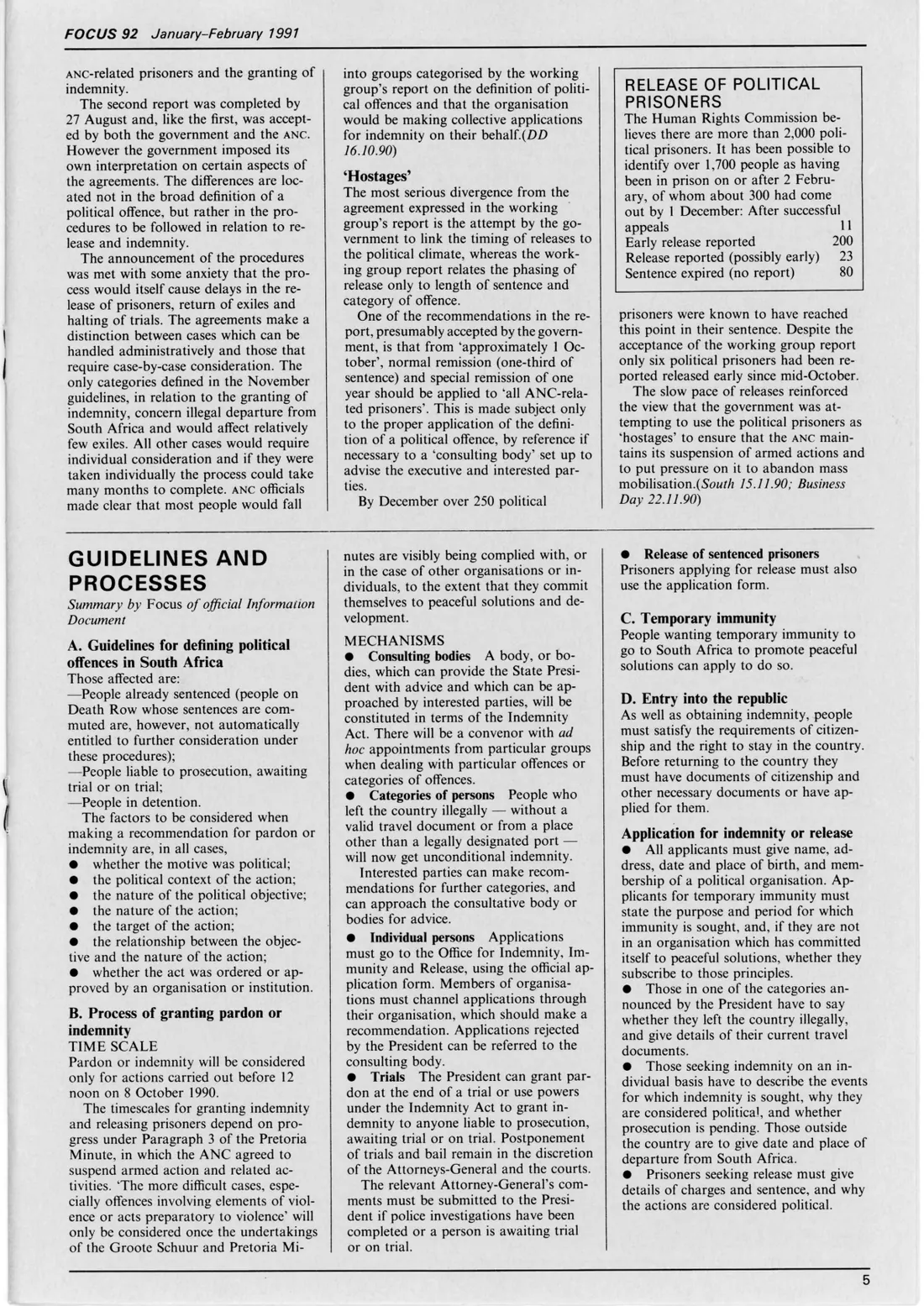
The government's policy on pardon and indemnity was set out in an information document released to the press on 2 November and published in the Government Gazette on 7 November.
The policy is based substantially on two reports of the joint ANC-Government working party on pardon and indemnity. The first report was concerned with the definition of a political offence. It was produced after the Groote Schuur meeting in May and was accepted in August at the Pretoria meeting, which asked the working group to draw up a plan for the phased release of ANC-related prisoners and the granting of indemnity.
The second report was completed by 27 August and, like the first, was accepted by both the government and the ANC. However the government imposed its own interpretation on certain aspects of the agreements. The differences are located not in the broad definition of a political offence, but rather in the procedures to be followed in relation to release and indemnity.
The announcement of the procedures was met with some anxiety that the process would itself cause delays in the release of prisoners, return of exiles and halting of trials. The agreements make a distinction between cases which can be handled administratively and those that require case-by-case consideration. The only categories defined in the November guidelines, in relation to the granting of indemnity, concern illegal departure from South Africa and would affect relatively few exiles. All other cases would require individual consideration and if they were taken individually the process could take many months to complete. ANC officials made clear that most people would fall into groups categorised by the working group's report on the definition of political offences and that the organisation would be making collective applications for indemnity on their behalf.
The most serious divergence from the agreement expressed in the working group's report is the attempt by the government to link the timing of releases to the political climate, whereas the working group report relates the phasing of release only to length of sentence and category of offence.
One of the recommendations in the report, presumably accepted by the government, is that from 'approximately 1 October', normal remission (one-third of sentence) and special remission of one year should be applied to 'all ANC-related prisoners'. This is made subject only to the proper application of the definition of a political offence, by reference if necessary to a 'consulting body' set up to advise the executive and interested parties.
By December over 250 political prisoners were known to have reached this point in their sentence. Despite the acceptance of the working group report only six political prisoners had been reported released early since mid-October.
The slow pace of releases reinforced the view that the government was attempting to use the political prisoners as 'hostages' to ensure that the ANC maintains its suspension of armed actions and to put pressure on it to abandon mass mobilisation.