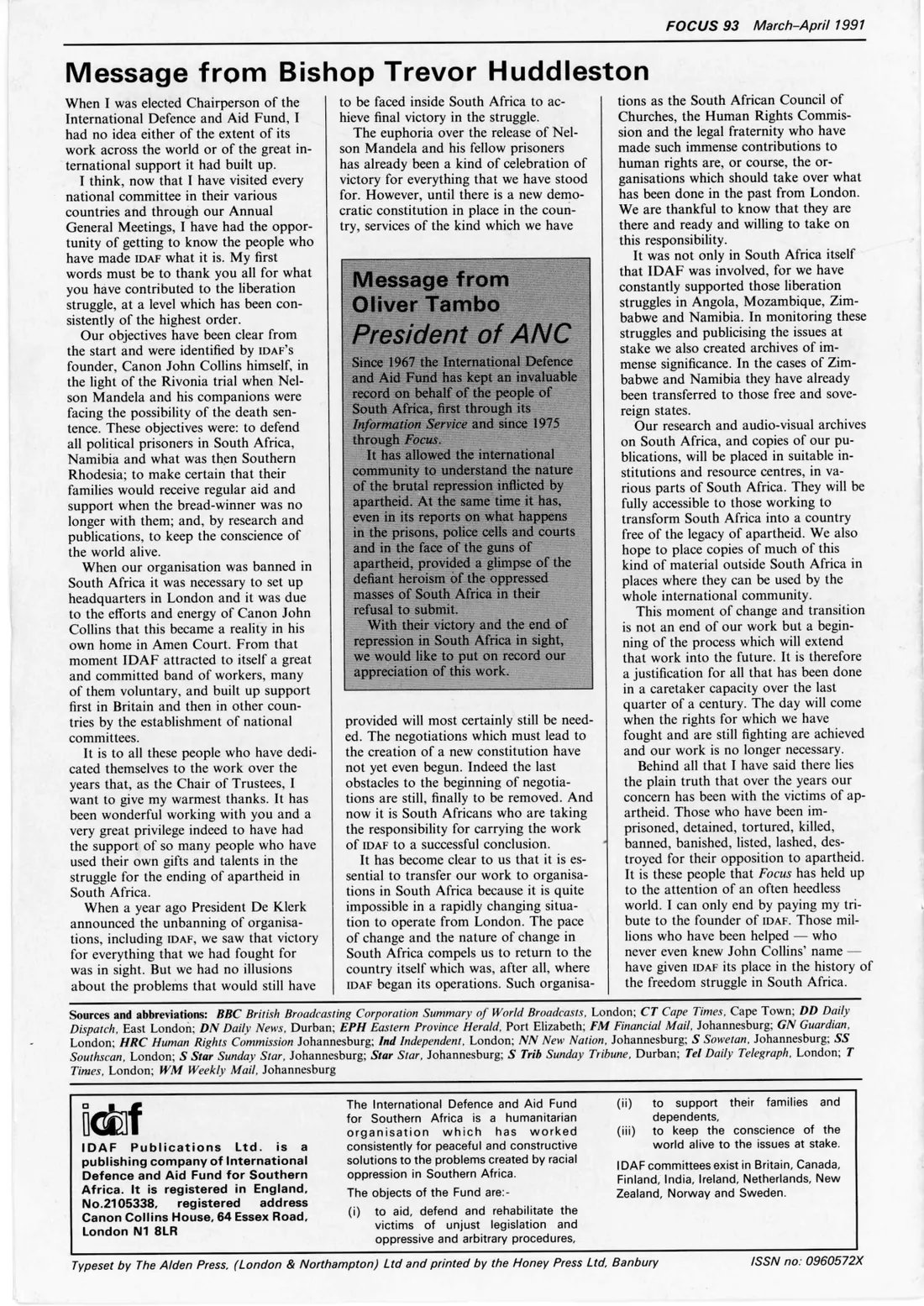
Message from Bishop Trevor Huddleston When I was elected Chairperson of the International Defence and Aid Fund, I had no idea either of the extent of its work across the world or of the great international support it had built up.
I think, now that I have visited every national committee in their various countries and through our Annual General Meetings, I have had the opportunity of getting to know the people who have made IDAF what it is. My first words must be to thank you all for what you have contributed to the liberation struggle, at a level which has been consistently of the highest order.
Our objectives have been clear from the start and were identified by IDAF's founder, Canon John Collins himself, in the light of the Rivonia trial when Nelson Mandela and his companions were facing the possibility of the death sentence. These objectives were: to defend all political prisoners in South Africa, Namibia and what was then Southern Rhodesia; to make certain that their families would receive regular aid and support when the bread-winner was no longer with them; and, by research and publications, to keep the conscience of the world alive.
When our organisation was banned in South Africa it was necessary to set up headquarters in London and it was due to the efforts and energy of Canon John Collins that this became a reality in his own home in Amen Court. From that moment IDAF attracted to itself a great and committed band of workers, many of them voluntary, and built up support first in Britain and then in other countries by the establishment of national committees.
It is to all these people who have dedicated themselves to the work over the years that, as the Chair of Trustees, I want to give my warmest thanks. It has been wonderful working with you and a very great privilege indeed to have had the support of so many people who have used their own gifts and talents in the struggle for the ending of apartheid in South Africa.
When a year ago President De Klerk announced the unbanning of organisations, including IDAF, we saw that victory for everything that we had fought for was in sight. But we had no illusions about the problems that would still have to be faced inside South Africa to achieve final victory in the struggle.
The euphoria over the release of Nelson Mandela and his fellow prisoners has already been a kind of celebration of victory for everything that we have stood for. However, until there is a new democratic constitution in place in the country, services of the kind which we have provided will most certainly still be needed. The negotiations which must lead to the creation of a new constitution have not yet even begun. Indeed the last obstacles to the beginning of negotiations are still, finally to be removed. And now it is South Africans who are taking the responsibility for carrying the work of IDAF to a successful conclusion.
It has become clear to us that it is essential to transfer our work to organisations in South Africa because it is quite impossible in a rapidly changing situation to operate from London. The pace of change and the nature of change in South Africa compels us to return to the country itself which was, after all, where IDAF began its operations. Such organisations as the South African Council of Churches, the Human Rights Commission and the legal fraternity who have made such immense contributions to human rights are, or course, the organisations which should take over what has been done in the past from London. We are thankful to know that they are there and ready and willing to take on this responsibility.
It was not only in South Africa itself that IDAF was involved, for we have constantly supported those liberation struggles in Angola, Mozambique, Zimbabwe and Namibia. In monitoring these struggles and publicising the issues at stake we also created archives of immense significance. In the cases of Zimbabwe and Namibia they have already been transferred to those free and sovereign states.
Our research and audio-visual archives on South Africa, and copies of our publications, will be placed in suitable institutions and resource centres, in various parts of South Africa. They will be fully accessible to those working to transform South Africa into a country free of the legacy of apartheid. We also hope to place copies of much of this kind of material outside South Africa in places where they can be used by the whole international community.
This moment of change and transition is not an end of our work but a beginning of the process which will extend that work into the future. It is therefore a justification for all that has been done in a caretaker capacity over the last quarter of a century. The day will come when the rights for which we have fought and are still fighting are achieved and our work is no longer necessary.
Behind all that I have said there lies the plain truth that over the years our concern has been with the victims of apartheid. Those who have been imprisoned, detained, tortured, killed, banned, banished, listed, lashed, destroyed for their opposition to apartheid. It is these people that Focus has held up to the attention of an often heedless world. I can only end by paying my tribute to the founder of IDAF. Those millions who have been helped — who never even knew John Collins' name — have given IDAF its place in the history of the freedom struggle in South Africa.
Message from Oliver Tambo President of ANC Since 1967 the International Defence and Aid Fund has kept an invaluable record on behalf of the people of South Africa, first through its Information Service and since 1975 through Focus.
It has allowed the international community to understand the nature of the brutal repression inflicted by apartheid. At the same time it has, even in its reports on what happens in the prisons, police cells and courts and in the face of the guns of apartheid, provided a glimpse of the defiant heroism of the oppressed masses of South Africa in their refusal to submit.
With their victory and the end of repression in South Africa in sight, we would like to put on record our appreciation of this work.