The continuing use of repression by the South African regime is surveyed.
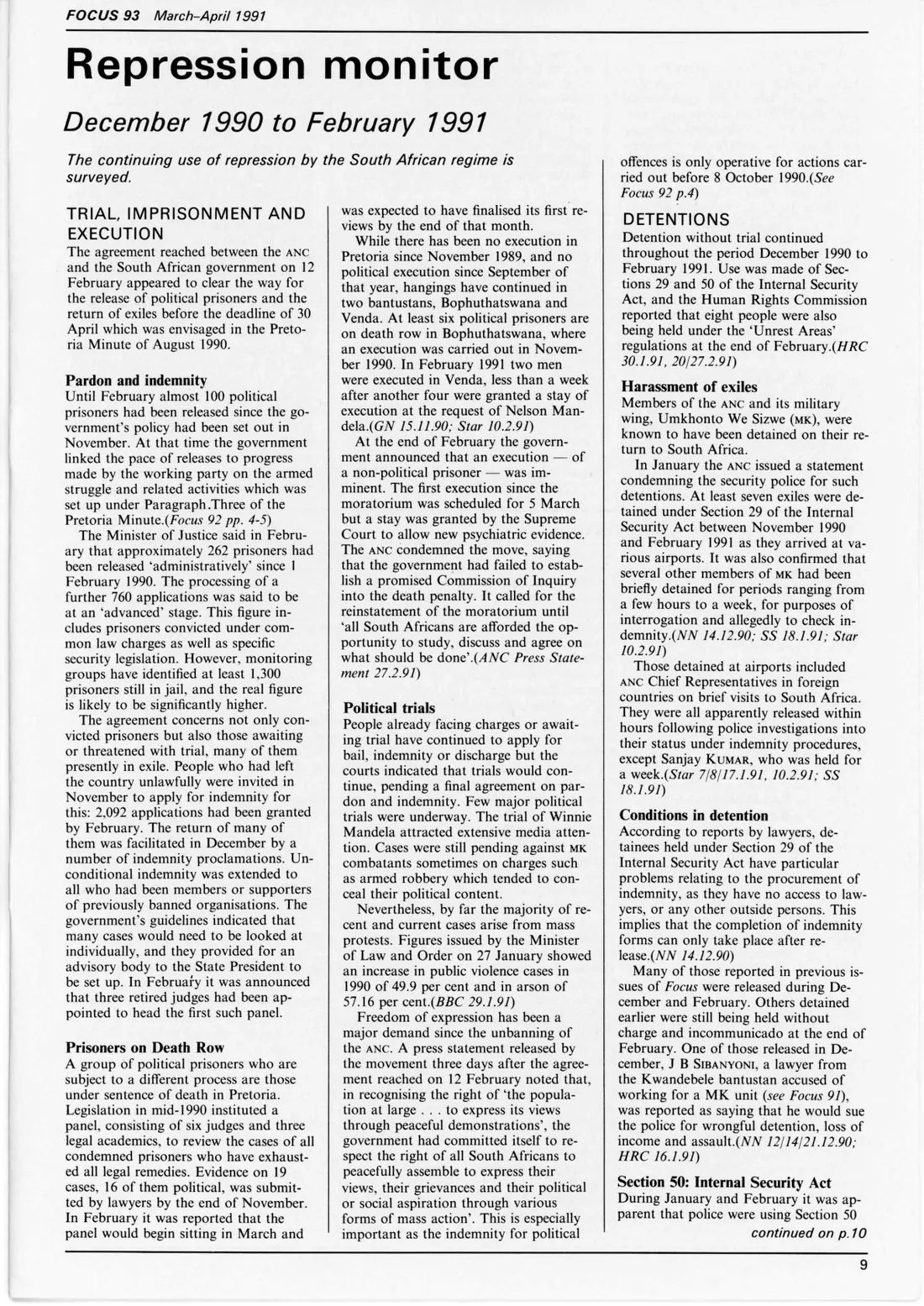
TRIAL, IMPRISONMENT AND EXECUTION The agreement reached between the ANC and the South African government on 12 February appeared to clear the way for the release of political prisoners and the return of exiles before the deadline of 30 April which was envisaged in the Pretoria Minute of August 1990.
Pardon and indemnity Until February almost 100 political prisoners had been released since the government's policy had been set out in November. At that time the government linked the pace of releases to progress made by the working party on the armed struggle and related activities which was set up under Paragraph Three of the Pretoria Minute.
The Minister of Justice said in February that approximately 262 prisoners had been released 'administratively' since 1 February 1990. The processing of a further 760 applications was said to be at an 'advanced' stage. This figure includes prisoners convicted under common law charges as well as specific security legislation. However, monitoring groups have identified at least 1,300 prisoners still in jail, and the real figure is likely to be significantly higher.
The agreement concerns not only convicted prisoners but also those awaiting or threatened with trial, many of them presently in exile. People who had left the country unlawfully were invited in November to apply for indemnity for this: 2,092 applications had been granted by February. The return of many of them was facilitated in December by a number of indemnity proclamations. Unconditional indemnity was extended to all who had been members or supporters of previously banned organisations. The government's guidelines indicated that many cases would need to be looked at individually, and they provided for an advisory body to the State President to be set up. In February it was announced that three retired judges had been appointed to head the first such panel.
Prisoners on Death Row A group of political prisoners who are subject to a different process are those under sentence of death in Pretoria. Legislation in mid-1990 instituted a panel, consisting of six judges and three legal academics, to review the cases of all condemned prisoners who have exhausted all legal remedies. Evidence on 19 cases, 16 of them political, was submitted by lawyers by the end of November. In February it was reported that the panel would begin sitting in March and was expected to have finalised its first reviews by the end of that month.
While there has been no execution in Pretoria since November 1989, and no political execution since September of that year, hangings have continued in two bantustans, Bophuthatswana and Venda. At least six political prisoners are on death row in Bophuthatswana, where an execution was carried out in November 1990. In February 1991 two men were executed in Venda, less than a week after another four were granted a stay of execution at the request of Nelson Mandela.
At the end of February the government announced that an execution — of a non-political prisoner — was imminent. The first execution since the moratorium was scheduled for 5 March but a stay was granted by the Supreme Court to allow new psychiatric evidence. The ANC condemned the move, saying that the government had failed to establish a promised Commission of Inquiry into the death penalty. It called for the reinstatement of the moratorium until 'all South Africans are afforded the opportunity to study, discuss and agree on what should be done'.
Political trials People already facing charges or awaiting trial have continued to apply for bail, indemnity or discharge but the courts indicated that trials would continue, pending a final agreement on pardon and indemnity. Few major political trials were underway. The trial of Winnie Mandela attracted extensive media attention. Cases were still pending against MK combatants sometimes on charges such as armed robbery which tended to conceal their political content.
Nevertheless, by far the majority of recent and current cases arise from mass protests. Figures issued by the Minister of Law and Order on 27 January showed an increase in public violence cases in 1990 of 49.9 per cent and in arson of 57.16 per cent.
Freedom of expression has been a major demand since the unbanning of the ANC. A press statement released by the movement three days after the agreement reached on 12 February noted that, in recognising the right of 'the population at large . . . to express its views through peaceful demonstrations', the government had committed itself to respect the right of all South Africans to peacefully assemble to express their views, their grievances and their political or social aspiration through various forms of mass action'. This is especially important as the indemnity for political offences is only operative for actions carried out before 8 October 1990.
DETENTIONS Detention without trial continued throughout the period December 1990 to February 1991. Use was made of Sections 29 and 50 of the Internal Security Act, and the Human Rights Commission reported that eight people were also being held under the 'Unrest Areas' regulations at the end of February.
Harassment of exiles Members of the ANC and its military wing, Umkhonto We Sizwe (MK), were known to have been detained on their return to South Africa.
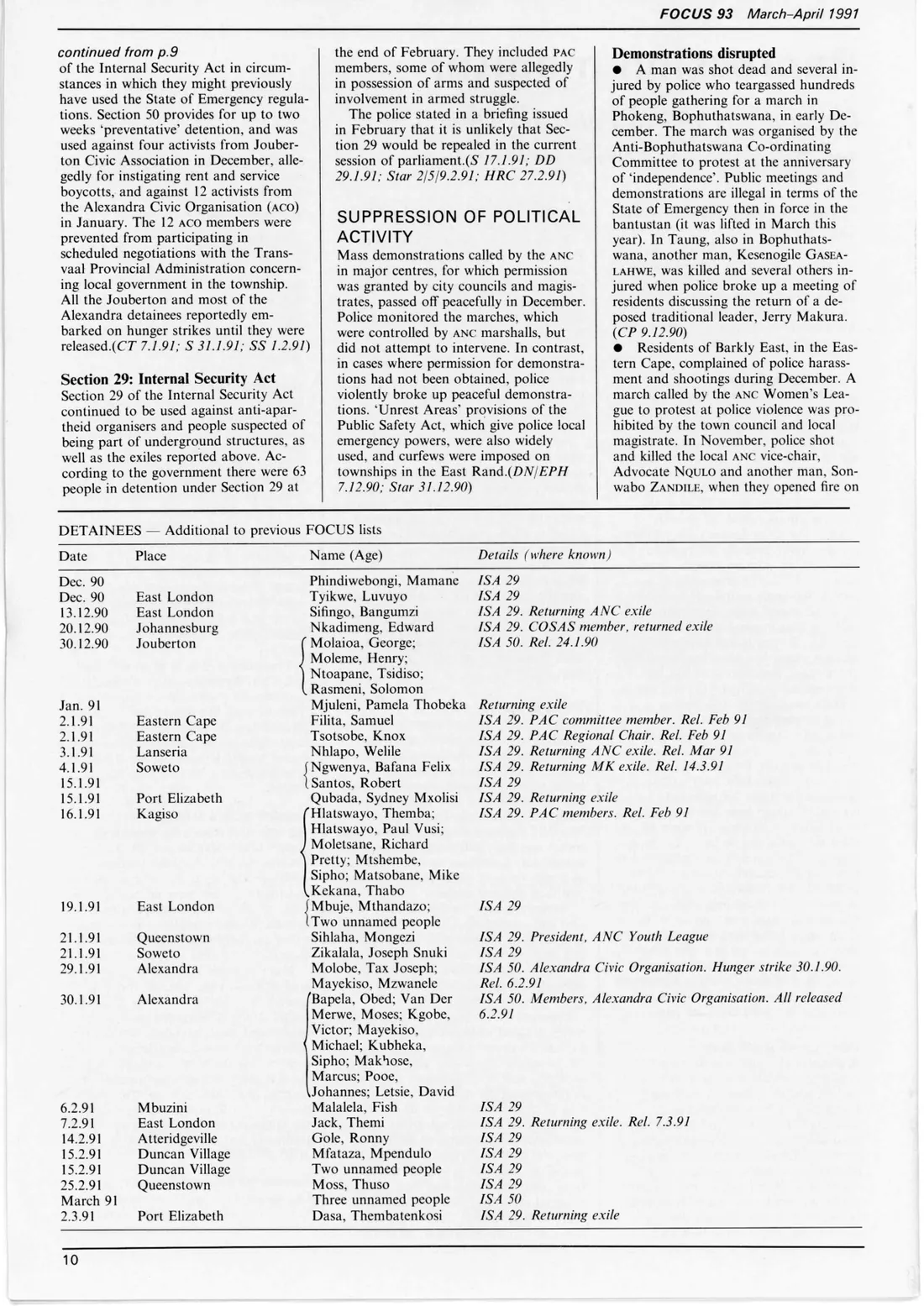
In January the ANC issued a statement condemning the security police for such detentions. At least seven exiles were detained under Section 29 of the Internal Security Act between November 1990 and February 1991 as it was also confirmed that several other members of MK had been briefly detained for periods ranging from a few hours to a week, for purposes of interrogation and allegedly to check indemnity.
Those detained at airports included ANC Chief Representatives in foreign countries on brief visits to South Africa. They were all apparently released within hours following police investigations into their status under indemnity procedures, except Sanjay KUMAR, who was held for a week.
Conditions in detention According to reports by lawyers, detainees held under Section 29 of the Internal Security Act have particular problems relating to the procurement of indemnity, as they have no access to lawyers, or any other outside persons. This implies that the completion of indemnity forms can only take place after release.
Many of those reported in previous issues of Focus were released during December and February. Others detained earlier were still being held without charge and incommunicado at the end of February. One of those released in December, J B SIBANYONI, a lawyer from the Kwandebele bantustan accused of working for a MK unit, was reported as saying that he would sue the police for wrongful detention, loss of income and assault.
Section 50: Internal Security Act During January and February it was apparent that police were using Section 50 of the Internal Security Act in circumstances in which they might previously have used the State of Emergency regulations. Section 50 provides for up to two weeks 'preventative' detention, and was used against four activists from Jouberton Civic Association in December, allegedly for instigating rent and service boycotts, and against 12 activists from the Alexandra Civic Organisation (ACO) in January. The 12 ACO members were prevented from participating in scheduled negotiations with the Transvaal Provincial Administration concerning local government in the township. All the Jouberton and most of the Alexandra detainees reportedly embarked on hunger strikes until they were released.
Section 29: Internal Security Act Section 29 of the Internal Security Act continued to be used against anti-apartheid organisers and people suspected of being part of underground structures, as well as the exiles reported above. According to the government there were 63 people in detention under Section 29 at the end of February. They included PAC members, some of whom were allegedly in possession of arms and suspected of involvement in armed struggle.
The police stated in a briefing issued in February that it is unlikely that Section 29 would be repealed in the current session of parliament.
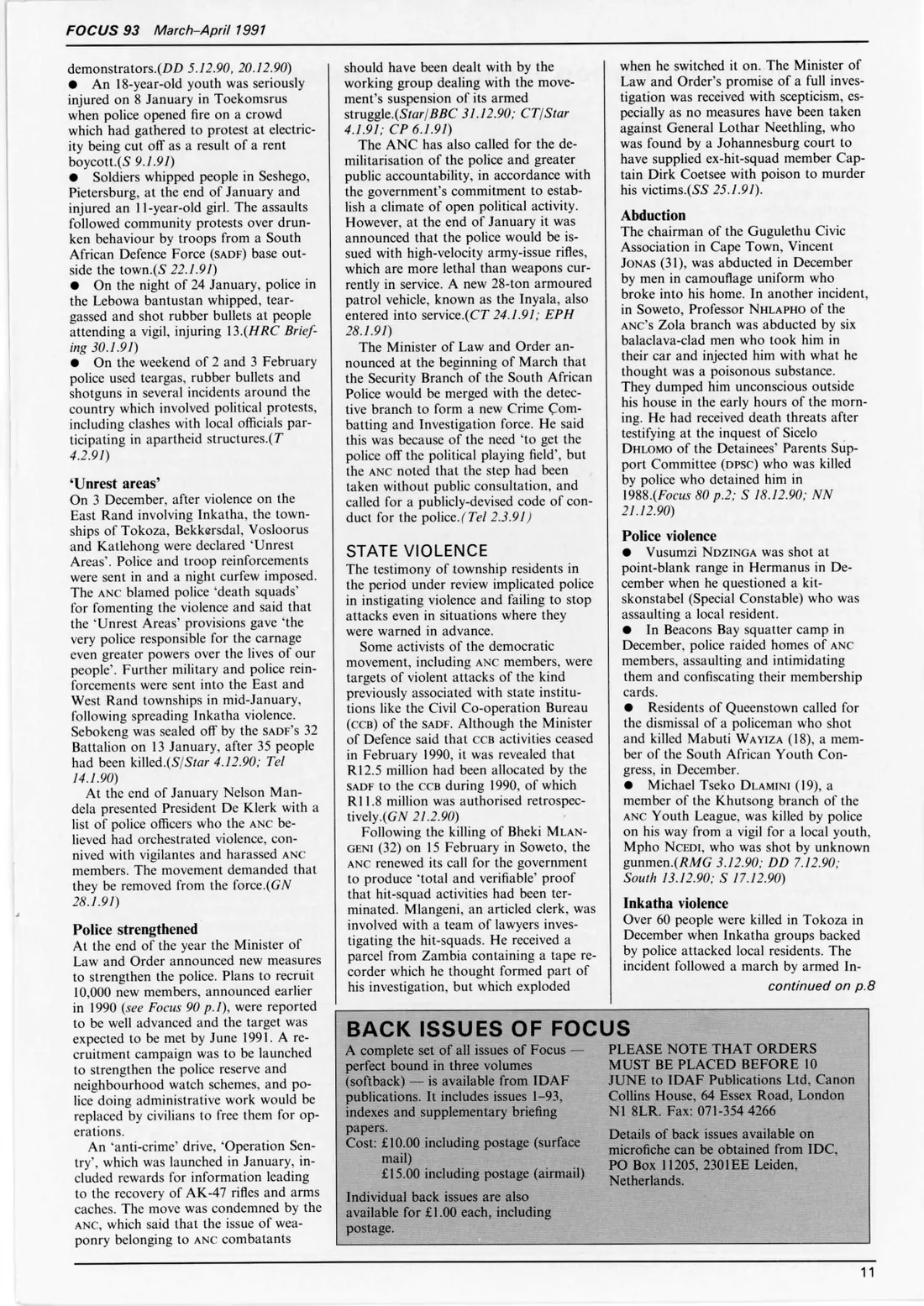
SUPPRESSION OF POLITICAL ACTIVITY Mass demonstrations called by the ANC in major centres, for which permission was granted by city councils and magistrates, passed off peacefully in December. Police monitored the marches, which were controlled by ANC marshalls, but did not attempt to intervene. In contrast, in cases where permission for demonstrations had not been obtained, police violently broke up peaceful demonstrations. 'Unrest Areas' provisions of the Public Safety Act, which give police local emergency powers, were also widely used, and curfews were imposed on townships in the East Rand.
Demonstrations disrupted * A man was shot dead and several injured by police who teargassed hundreds of people gathering for a march in Phokeng, Bophuthatswana, in early December. The march was organised by the Anti-Bophuthatswana Co-ordinating Committee to protest at the anniversary of 'independence'. Public meetings and demonstrations are illegal in terms of the State of Emergency then in force in the bantustan (it was lifted in March this year). In Taung, also in Bophuthatswana, another man, Kesenogile GASELAHWE, was killed and several others injured when police broke up a meeting of residents discussing the return of a deposed traditional leader, Jerry Makura. * Residents of Barkly East, in the Eastern Cape, complained of police harassment and shootings during December. A march called by the ANC Women's League to protest at police violence was prohibited by the town council and local magistrate. In November, police shot and killed the local ANC vice-chair, Advocate NQULO and another man, Sonwabo ZANDILE, when they opened fire on demonstrators. * An 18-year-old youth was seriously injured on 8 January in Toekomsrus when police opened fire on a crowd which had gathered to protest at electricity being cut off as a result of a rent boycott. * Soldiers whipped people in Seshego, Pietersburg, at the end of January and injured an 11-year-old girl. The assaults followed community protests over drunken behaviour by troops from a South African Defence Force (SADF) base outside the town. * On the night of 24 January, police in the Lebowa bantustan whipped, tear-gassed and shot rubber bullets at people attending a vigil, injuring 13. * On the weekend of 2 and 3 February police used teargas, rubber bullets and shotguns in several incidents around the country which involved political protests, including clashes with local officials participating in apartheid structures.
‘Unrest areas’ On 3 December, after violence on the East Rand involving Inkatha, the townships of Tokoza, Bekkersdal, Vosloorus and Katlehong were declared ‘Unrest Areas’. Police and troop reinforcements were sent in and a night curfew imposed. The ANC blamed police ‘death squads’ for fomenting the violence and said that the ‘Unrest Areas’ provisions gave ‘the very police responsible for the carnage even greater powers over the lives of our people’. Further military and police reinforcements were sent into the East and West Rand townships in mid-January, following spreading Inkatha violence. Sebokeng was sealed off by the SADF’s 32 Battalion on 13 January, after 35 people had been killed.
At the end of January Nelson Mandela presented President De Klerk with a list of police officers who the ANC believed had orchestrated violence, connived with vigilantes and harassed ANC members. The movement demanded that they be removed from the force.
Police strengthened At the end of the year the Minister of Law and Order announced new measures to strengthen the police. Plans to recruit 10,000 new members, announced earlier in 1990, were reported to be well advanced and the target was expected to be met by June 1991. A recruitment campaign was to be launched to strengthen the police reserve and neighbourhood watch schemes, and police doing administrative work would be replaced by civilians to free them for operations.
An ‘anti-crime’ drive, ‘Operation Security’, which was launched in January, included rewards for information leading to the recovery of AK-47 rifles and arms caches. The move was condemned by the ANC, which said that the issue of weaponry belonging to ANC combatants should have been dealt with by the working group dealing with the movement’s suspension of its armed struggle.
The ANC has also called for the demilitarisation of the police and greater public accountability, in accordance with the government's commitment to establish a climate of open political activity. However, at the end of January it was announced that the police would be issued with high-velocity army-issue rifles, which are more lethal than weapons currently in service. A new 28-ton armoured patrol vehicle, known as the Inyala, also entered into service.
The Minister of Law and Order announced at the beginning of March that the Security Branch of the South African Police would be merged with the detective branch to form a new Crime Combating and Investigation force. He said this was because of the need 'to get the police off the political playing field', but the ANC noted that the step had been taken without public consultation, and called for a publicly-devised code of conduct for the police.
STATE VIOLENCE The testimony of township residents in the period under review implicated police in instigating violence and failing to stop attacks even in situations where they were warned in advance.
Some activists of the democratic movement, including ANC members, were targets of violent attacks of the kind previously associated with state institutions like the Civil Co-operation Bureau (CCB) of the SADF. Although the Minister of Defence said that CCB activities ceased in February 1990, it was revealed that R12.5 million had been allocated by the SADF to the CCB during 1990, of which R11.8 million was authorised retrospectively.
Following the killing of Bheki Mlangeni (32) on 15 February in Soweto, the ANC renewed its call for the government to produce ‘total and verifiable’ proof that hit-squad activities had been terminated. Mlangeni, an articled clerk, was involved with a team of lawyers investigating the hit-squads. He received a parcel from Zambia containing a tape recorder which he thought formed part of his investigation, but which exploded when he switched it on. The Minister of Law and Order's promise of a full investigation was received with scepticism, especially as no measures have been taken against General Lothar Neethling, who was found by a Johannesburg court to have supplied ex-hit-squad member Captain Dirk Coetsee with poison to murder his victims.
Abduction The chairman of the Gugulethu Civic Association in Cape Town, Vincent JONAS (31), was abducted in December by men in camouflage uniform who broke into his home. In another incident, in Soweto, Professor NHLAPHO of the ANC's Zola branch was abducted by six balaclava-clad men who took him in their car and injected him with what he thought was a poisonous substance. They dumped him unconscious outside his house in the early hours of the morning. He had received death threats after testifying at the inquest of Sicelo DHLOMO of the Detainees' Parents Support Committee (DPSC) who was killed by police who detained him in 1988.
Police violence * Vusumzi NDZINGA was shot at point-blank range in Hermanus in December when he questioned a kitsonstabel (Special Constable) who was assaulting a local resident. * In Beacons Bay squatter camp in December, police raided homes of ANC members, assaulting and intimidating them and confiscating their membership cards. * Residents of Queenstown called for the dismissal of a policeman who shot and killed Mabuti WAYIZA (18), a member of the South African Youth Congress, in December. * Michael Tseko DLAMINI (19), a member of the Khutsong branch of the ANC Youth League, was killed by police on his way from a vigil for a local youth, Mpho NCEDI, who was shot by unknown gunmen.
Inkatha violence Over 60 people were killed in Tokoza in December when Inkatha groups backed by police attacked local residents. The incident followed a march by armed Inkatha supporters which went off peacefully. Some of them, who lived in the hostels near Phola Park squatter camp, marched back to their hostels. Local residents, fearing an attack, fought to repel them. Police fired teargas at the residents; the ANC said eyewitnesses saw police armoured vehicles leading a charge by Inkatha members.
A delegation of about 50 prominent people was organised by the South African Council of Churches (SACC) to tour the affected area and calm down the violence. The government declared a few and sent troops and police reinforcements. Both the ANC and Inkatha criticised the role played by the police and agreed to try to restore peace. Among the forces deployed were members of 32 Battalions and ex-members of the South African police unit Koevoet, which residents thought contributed to the deaths.
Sebokeng massacre Thirty-five people were killed in Sebokeng in January when unknown gunmen thought to be local gangsters attacked a vigil to mourn Christopher Mphikeleli NANGALEMBE (29), the Vaal organiser of the ANC Youth League. His brother Mandla had received reports on 5 January that he had been abducted by the gang and forced into a car boot. He sought police assistance but met with no co-operation. The following day his brother was found strangled with a piece of wire.
Mandla then heard that the gang intended killing his entire family and he reported the matter to the police. A local priest and representative of the SACC sought police intervention when he heard the family concern about a planned attack on the vigil. Fifteen minutes before the attack, street lights in the area went off. Shots were later fired indiscriminately at the crowd which formed the vigil.
Police claims that they went to the vigil to offer protection, only to be turned back by 'comrades', were dismissed by local ANC officials. Nelson Mandela and Walter Sisulu, who both visited the scene, blamed the police for the massacre.