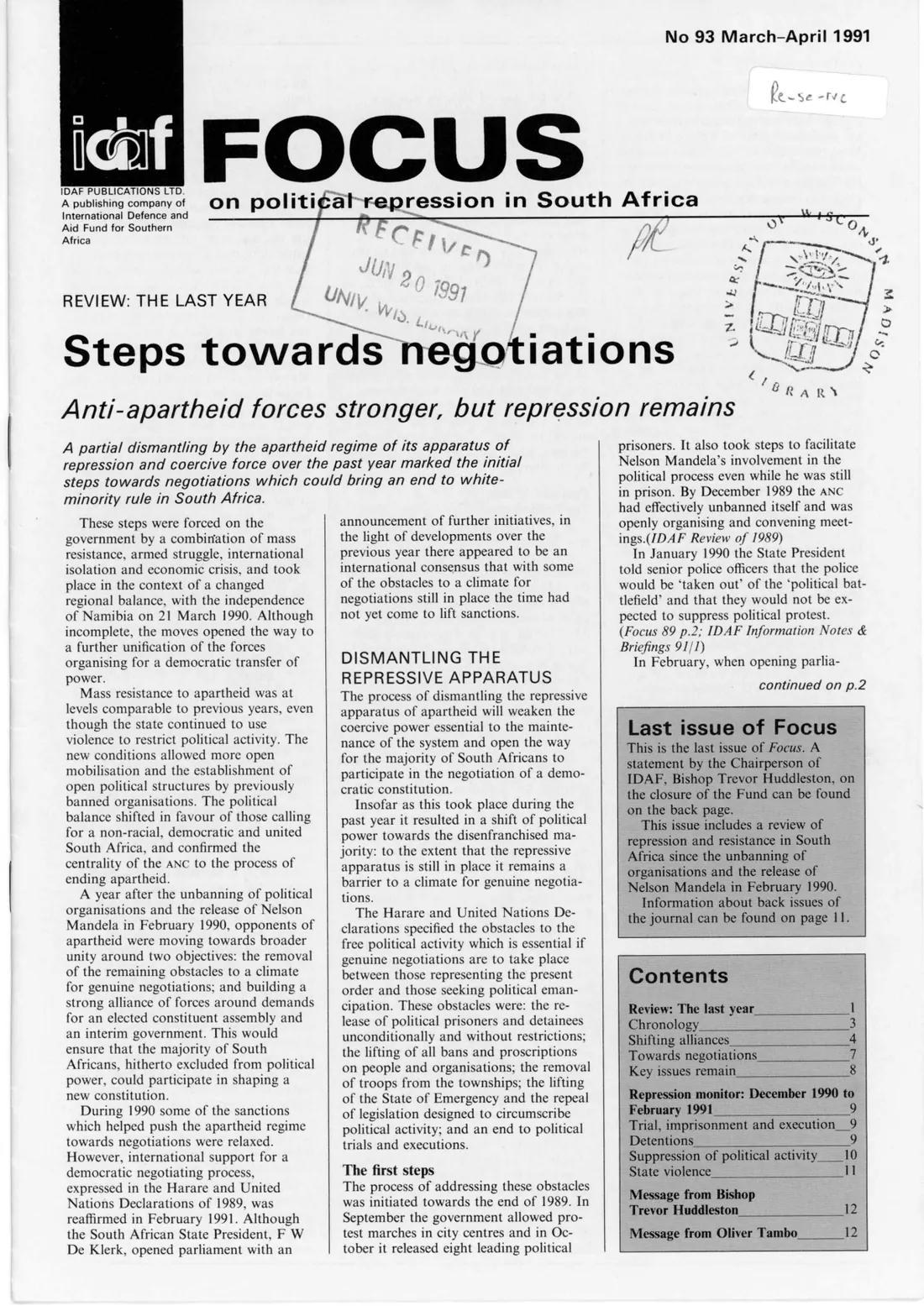
A partial dismantling by the apartheid regime of its apparatus of repression and coercive force over the past year marked the initial steps towards negotiations which could bring an end to white-minority rule in South Africa.
These steps were forced on the government by a combination of mass resistance, armed struggle, international isolation and economic crisis, and took place in the context of a changed regional balance, with the independence of Namibia on 21 March 1990. Although incomplete, the moves opened the way to a further unification of the forces organising for a democratic transfer of power.
Mass resistance to apartheid was at levels comparable to previous years, even though the state continued to use violence to restrict political activity. The new conditions allowed more open mobilisation and the establishment of open political structures by previously banned organisations. The political balance shifted in favour of those calling for a non-racial, democratic and united South Africa, and confirmed the centrality of the ANC to the process of ending apartheid.
A year after the unbanning of political organisations and the release of Nelson Mandela in February 1990, opponents of apartheid were moving towards broader unity around two objectives: the removal of the remaining obstacles to a climate for genuine negotiations; and building a strong alliance of forces around demands for an elected constituent assembly and an interim government. This would ensure that the majority of South Africans, hitherto excluded from political power, could participate in shaping a new constitution.
During 1990 some of the sanctions which helped push the apartheid regime towards negotiations were relaxed. However, international support for a democratic negotiating process, expressed in the Harare and United Nations Declarations of 1989, was reaffirmed in February 1991. Although the South African State President, F W De Klerk, opened parliament with an announcement of further initiatives, in the light of developments over the previous year there appeared to be an international consensus that with some of the obstacles to a climate for negotiations still in place the time had not yet come to lift sanctions.