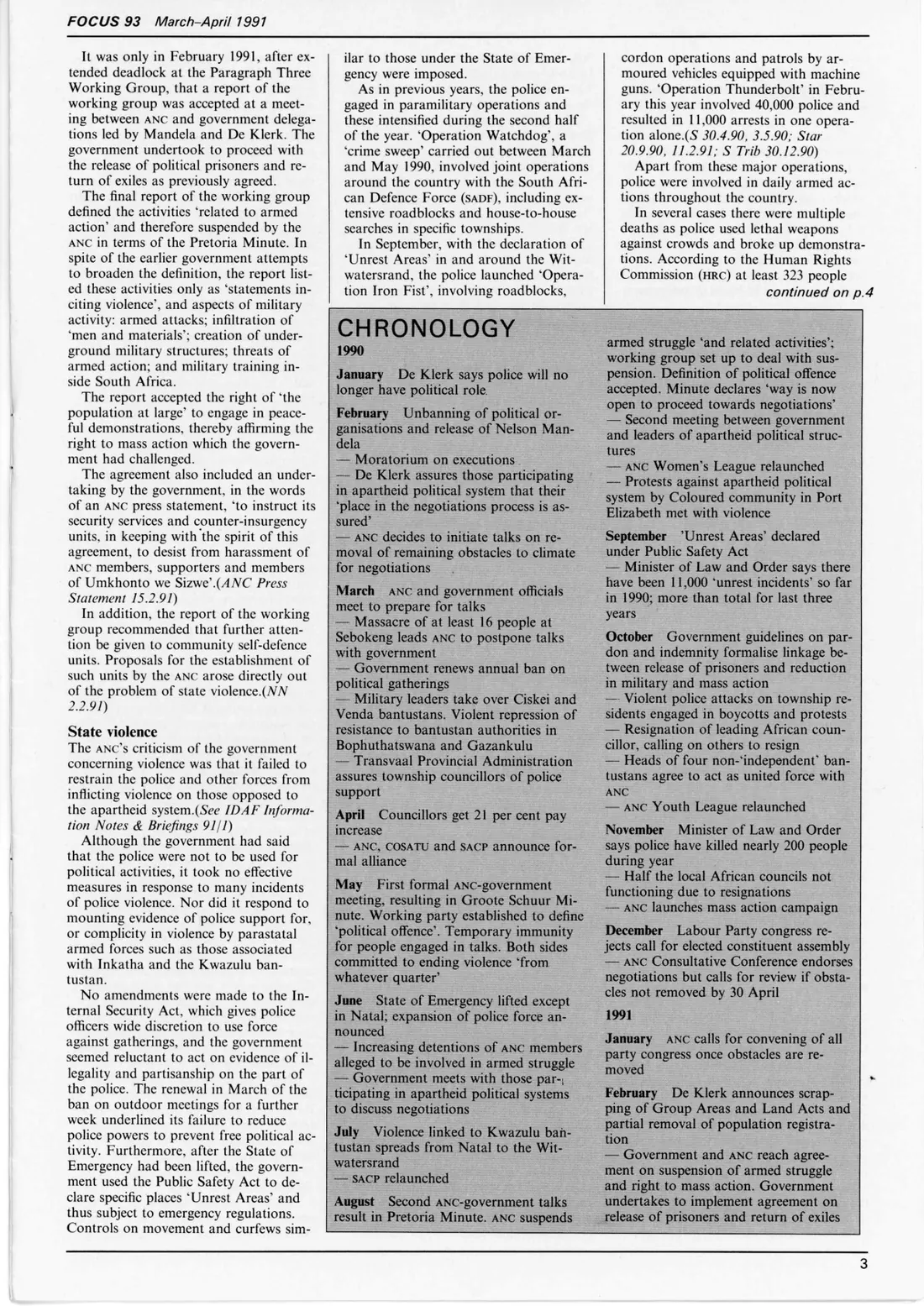
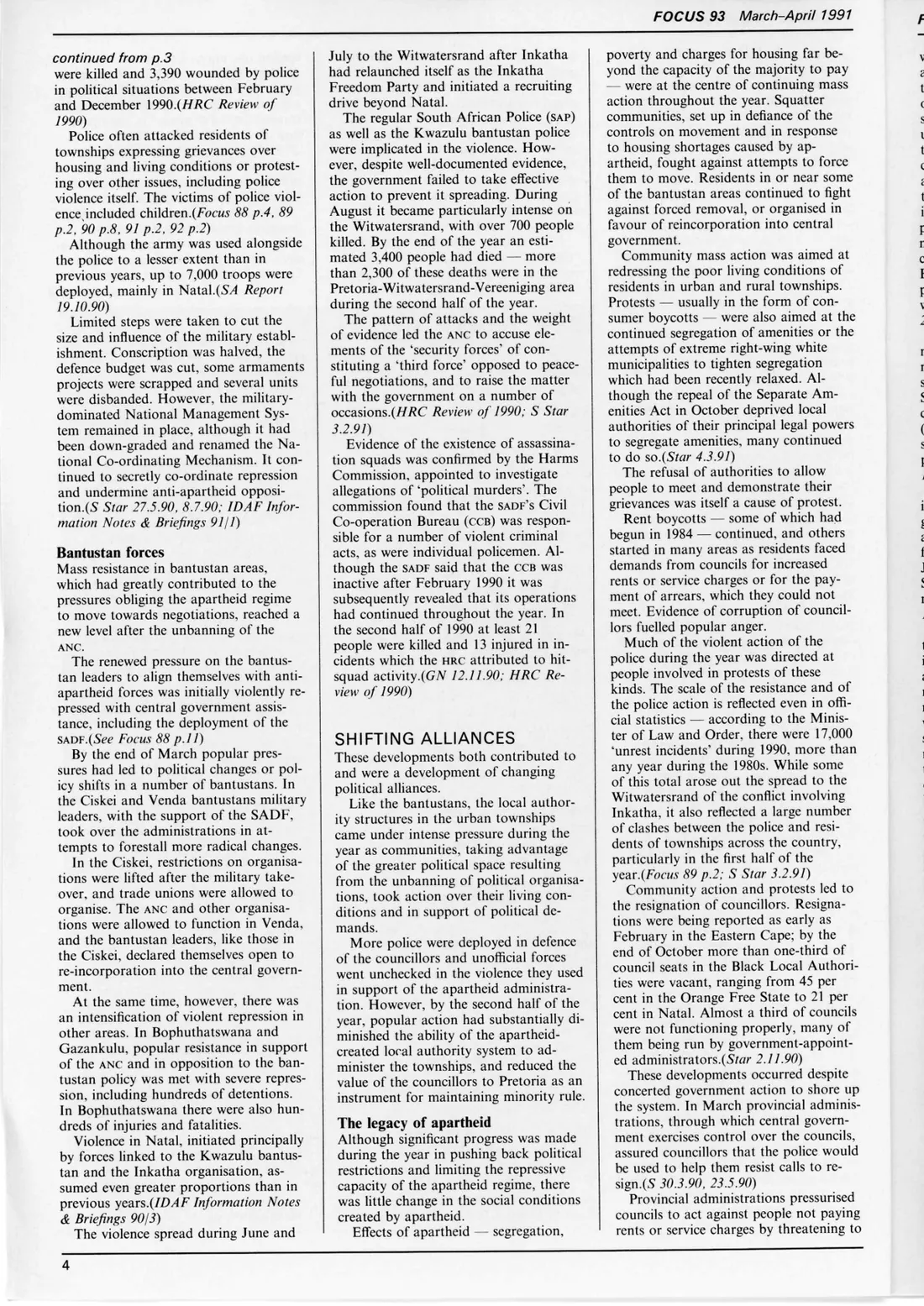
The ANC's criticism of the government concerning violence was that it failed to restrain the police and other forces from inflicting violence on those opposed to the apartheid system.
Although the government had said that the police were not to be used for political activities, it took no effective measures in response to many incidents of police violence. Nor did it respond to mounting evidence of police support for, or complicity in violence by parastatal armed forces such as those associated with Inkatha and the Kwazulu-bantustan.
No amendments were made to the Internal Security Act, which gives police officers wide discretion to use force against gatherings, and the government seemed reluctant to act on evidence of illegality and partisanship on the part of the police. The renewal in March of the ban on outdoor meetings for a further week underlined its failure to reduce police powers to prevent free political activity. Furthermore, after the State of Emergency had been lifted, the government used the Public Safety Act to declare specific places 'Unrest Areas' and thus subject to emergency regulations. Controls on movement and curfews similar to those under the State of Emergency were imposed.
As in previous years, the police engaged in paramilitary operations and these intensified during the second half of the year. 'Operation Watchdog', a 'crime sweep' carried out between March and May 1990, involved joint operations around the country with the South African Defence Force (SADF), including extensive roadblocks and house-to-house searches in specific townships.
In September, with the declaration of 'Unrest Areas' in and around the Witwatersrand, the police launched 'Operation Iron Fist', involving roadblocks, cordon operations and patrols by armoured vehicles equipped with machine guns. 'Operation Thunderbolt' in February this year involved 40,000 police and resulted in 11,000 arrests in one operation alone. Apart from these major operations, police were involved in daily armed actions throughout the country.
In several cases there were multiple deaths as police used lethal weapons against crowds and broke up demonstrations. According to the Human Rights Commission (HRC) at least 323 people were killed and 3,390 wounded by police in political situations between February and December 1990.
Police often attacked residents of townships expressing grievances over housing and living conditions or protesting over other issues, including police violence itself. The victims of police violence included children.
Although the army was used alongside the police to a lesser extent than in previous years, up to 7,000 troops were deployed, mainly in Natal.
Limited steps were taken to cut the size and influence of the military establishment. Conscription was halved, the defence budget was cut, some armaments projects were scrapped and several units were disbanded. However, the military-dominated National Management System remained in place, although it had been down-graded and renamed the National Co-ordinating Mechanism. It continued to secretly co-ordinate repression and undermine anti-apartheid opposition.